
Given below are four plots obtained from separate experiments on enzyme inhibition kinetics. The velocity (v) of the reaction is plotted at varying concentrations of substrate (s) and inhibitor (I). The plot(s) corresponding to competitive inhibition is/are 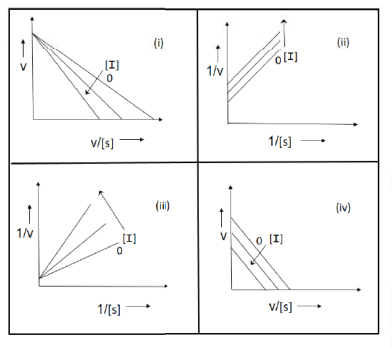
1. Characteristics of Competitive Inhibition:
In competitive inhibition, the inhibitor competes with the substrate for the active site. This results in:
- The maximum velocity (Vmax) remaining unchanged because high substrate concentrations can eventually outcompete the inhibitor.
- An increase in the Michaelis constant (Km), meaning a higher concentration of substrate is needed to reach half of Vmax.
2. Analysis of the Plots:
Plot (i) - Eadie-Hofstee Plot (v vs. v/[s]):
The equation is v = -Km(v/[s]) + Vmax. Here, Vmax is the y-intercept. In Plot (i), all lines for different inhibitor concentrations [I] intersect at the same point on the y-axis, indicating a constant Vmax. The slope (-Km) becomes steeper as [I] increases, representing an increased Km. This corresponds to competitive inhibition.
Plot (iii) - Lineweaver-Burk Plot (1/v vs. 1/[s]):
The equation is 1/v = (Km/Vmax)(1/[s]) + 1/Vmax. Here, 1/Vmax is the y-intercept. In Plot (iii), all lines intersect at the same point on the y-axis, confirming Vmax is constant. The different slopes represent the change in Km. This also corresponds to competitive inhibition.
Other Plots:
- Plot (ii) shows parallel lines in a double-reciprocal plot, which is characteristic of uncompetitive inhibition (both Vmax and Km change proportionately).
- Plot (iv) shows a change in y-intercept on the Eadie-Hofstee plot, indicating a change in Vmax, which is characteristic of non-competitive inhibition.
Final Answer:
The plots corresponding to competitive inhibition are (i) and (iii). Therefore, the correct choices are Option 1 and Option 3.
Important Questions from Enzyme Kinetics Competitive Inhibition
- The CORRECT statement(s) about a competitive inhibitor of an enzyme is/are
- For a simple enzyme that follows Michaelis-Menten kinetics, kinetic data was collected in the absence (dotted line, -I), or presence (solid line, +I) of an uncompetitive inhibitor (I). Which one of the following Eadie-Hofstee plots best describes the expected result?
($v_0$ = initial velocity, $[S]$ = free substrate concentration) - Researchers measure the activity of an enzyme in the presence of an inhibitor. They observe that
- $V_{\text{max}}$ of the enzyme remains unchanged at saturating substrate concentration
- $K_m$ increases compared to uninhibited enzyme
The kinetics of an enzyme in the presence (+I) or absence (-I) of a reversible inhibitor is described in the following graph.
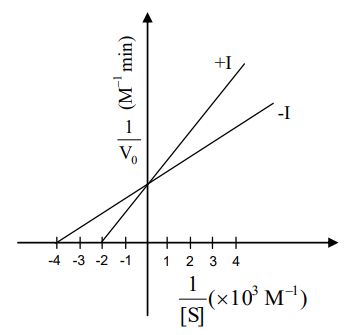
If concentration of the reversible inhibitor in +I experiment was equal to $3.0 \times 10^{-3}$ M, then the dissociation constant for the enzyme-inhibitor complex is
- In an in vitro dehydrogenation reaction of succinate catalyzed by succinate dehydrogenase, malonate is added. Which one of the following curves represents the effect of malonate on the catalysis of succinate dehydrogenase?


