
Question
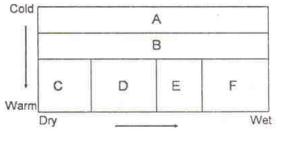
From the given table, identify ecozones A, B and C.A B C Phytomass (Total) very small medium very high Leaf area index very small medium very high Decay period of organic matter very high small very small
The correct answer is
A – Polar, B – Seasonal tropics, C – Humid subtropics
Let's analyze the data provided in the table to match the ecozones A, B, and C with the correct descriptions from the given options.
- Phytomass (Total):
- A: Very small - This is characteristic of regions with limited vegetation like Polar regions.
- B: Medium - This can be found in areas with moderate vegetation, such as Seasonal tropics.
- C: Very high - Suggestive of dense vegetation typically found in Humid subtropics.
- Leaf Area Index:
- A: Very small - Again, indicative of sparse vegetation like in Polar regions.
- B: Medium - Represents moderate vegetation area like in Seasonal tropics.
- C: Very high - Seen in regions with dense foliage such as Humid subtropics.
- Decay Period of Organic Matter:
- A: Very high - The organic matter decay is slow due to low temperatures which is typical in Polar regions.
- B: Small - A moderate decay period, seen in warmer regions like Seasonal tropics where decomposition is faster than in colder areas.
- C: Very small - Rapid decomposition is often found in Humid subtropics due to favorable warm and moist conditions.
Comparing these characteristics with the options provided:
- Option 1: A – Humid mid-latitude, B – Grass steppe, C – Humid subtropics - Does not match because Humid mid-latitude would not have very small phytomass and leaf area index.
- Option 2: A – Polar, B – Arid-latitude, C – Seasonal tropics - Incorrect as this would mismatch the characteristics for phytomass and decay rates.
- Option 3: A – Arid-latitude, B – Polar, C – Humid subtropics - Incorrect, similar reasoning as before.
- Option 4: A – Polar, B – Seasonal tropics, C – Humid subtropics - Correct selection because it precisely matches all the characteristics discussed.
Thus, the correct answer is:
A – Polar, B – Seasonal tropics, C – Humid subtropics.
Was this answer helpful?
Important Questions from Bio-Geography
- Ecological succession in the upwelling region of the Southwest coast of India can be best exemplified by
- Match the forests with their characters
Forests Characters A. Subtropical evergreen forest P. The trees are spaced widely apart B. Savanna woodland Q. Trees with small hard leathery leave C. Sclerophyll forest R. Straight trunked cone-shaped trees with relatively short branched and small, narrow needle like leaves D. Boreal forest S. Broad leaf T. Needle leaf Indentify the biomes
Match the ecological adaptive strategies with the plant types
Plant Type Adaptive strategies A. Hydrophytes E. germination of seeds before they shed; adventitious roots that develop from the base of the stem; negatively geotropic roots for supply of oxygen B. Mesophytes F. root systems are very deep; stems are dwarf and branched; stomata are less in number and generally confined to the lower surface of leaves C. Xerophytes G. leaves are thin, narrow, and linear; extensive aerenchyma in all organs; stomata are generally absent D. Halophytes H. leaves are large; stem is rigid and stout; normal physiological processes
Choose the correct option- Which one of the following terrestrial biomes is found in regions dominantly characterized by oxisols?
Need Expert Advice?


