
Ecological Succession on India's Southwest Coast
Ecological succession refers to the gradual process by which ecosystems change over time. In the context of the Southwest coast of India, particularly during the monsoon season, upwelling brings nutrient-rich deep water to the surface. This nutrient influx supports a specific sequence of organisms, starting with primary producers and moving up through various consumer levels.
Understanding Upwelling Ecosystem Dynamics
Upwelling regions are characterized by a rapid increase in primary productivity:
- Nutrient Enrichment: Deep ocean currents bring essential nutrients to the sunlit surface layers.
- Phytoplankton Blooms: Diatoms and other phytoplankton thrive, forming the base of the food web.
- Zooplankton Grazing: Zooplankton populations increase by feeding on the abundant phytoplankton.
- Fish Predation: Small fish that feed on zooplankton become abundant, followed by larger predatory fish.
Analyzing the Food Chain Progression (Option B)
Option B correctly represents a typical ecological succession pathway in this environment:
This sequence details the trophic levels:
- Primary Producer: Fragellaria oceanica is a type of diatom (phytoplankton) that forms the base of the food web using nutrients and sunlight.
- Primary Consumer: Acartia tonsa is a copepod (zooplankton) that consumes the phytoplankton.
- Secondary Consumer: Anchoviella indica is a small fish (anchovy) that feeds on zooplankton.
- Tertiary Consumer: Scombermneus commersoni is a larger fish (e.g., King Mackerel) that preys on smaller fish like anchovies.
This ordered progression from producers to higher-level consumers exemplifies ecological succession driven by upwelling dynamics.
Important Questions from Bio-Geography
- Match the forests with their characters
Forests Characters A. Subtropical evergreen forest P. The trees are spaced widely apart B. Savanna woodland Q. Trees with small hard leathery leave C. Sclerophyll forest R. Straight trunked cone-shaped trees with relatively short branched and small, narrow needle like leaves D. Boreal forest S. Broad leaf T. Needle leaf Indentify the biomes
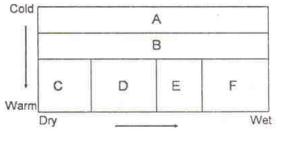
Match the ecological adaptive strategies with the plant types
Plant Type Adaptive strategies A. Hydrophytes E. germination of seeds before they shed; adventitious roots that develop from the base of the stem; negatively geotropic roots for supply of oxygen B. Mesophytes F. root systems are very deep; stems are dwarf and branched; stomata are less in number and generally confined to the lower surface of leaves C. Xerophytes G. leaves are thin, narrow, and linear; extensive aerenchyma in all organs; stomata are generally absent D. Halophytes H. leaves are large; stem is rigid and stout; normal physiological processes
Choose the correct option- Which one of the following terrestrial biomes is found in regions dominantly characterized by oxisols?
- Where rainfall is higher, the grassland biome steppe grades into


