
Match the ecological adaptive strategies with the plant types
Plant Type Adaptive strategies A. Hydrophytes E. germination of seeds before they shed; adventitious roots that develop from the base of the stem; negatively geotropic roots for supply of oxygen B. Mesophytes F. root systems are very deep; stems are dwarf and branched; stomata are less in number and generally confined to the lower surface of leaves C. Xerophytes G. leaves are thin, narrow, and linear; extensive aerenchyma in all organs; stomata are generally absent D. Halophytes H. leaves are large; stem is rigid and stout; normal physiological processes
Choose the correct option
Plant Adaptation Strategies Matching Solution
This solution matches specific plant types with their ecological adaptive strategies based on the provided options.
Detailed Matching:
- A. Hydrophytes are matched with G.
- Reasoning: Hydrophytes live in waterlogged conditions. Strategy G highlights 'extensive aerenchyma' (air channels for buoyancy and gas exchange), 'thin, narrow, and linear leaves' (common in submerged plants), and 'stomata generally absent' (gas exchange often occurs via other surfaces).
- B. Mesophytes are matched with H.
- Reasoning: Mesophytes thrive in moderate conditions. Strategy H describes 'large leaves' (efficient photosynthesis), 'normal physiological processes', and a 'rigid and stout stem' which are typical characteristics.
- C. Xerophytes are matched with F.
- Reasoning: Xerophytes are adapted to arid environments. Strategy F correctly identifies 'root systems are very deep' (water absorption), stems that are 'dwarf and branched' (reduce surface area), and 'stomata are less in number and generally confined to the lower surface' (minimize water loss).
- D. Halophytes are matched with E.
- Reasoning: Halophytes are adapted to saline environments. Strategy E includes 'germination of seeds before they shed' (vivipary, common in mangroves), 'adventitious roots', and 'negatively geotropic roots' (like pneumatophores for oxygen in saline, waterlogged soil).
Therefore, the correct matching sequence is A-G, B-H, C-F, D-E, corresponding to Option B.
Important Questions from Bio-Geography
- Ecological succession in the upwelling region of the Southwest coast of India can be best exemplified by
- Match the forests with their characters
Forests Characters A. Subtropical evergreen forest P. The trees are spaced widely apart B. Savanna woodland Q. Trees with small hard leathery leave C. Sclerophyll forest R. Straight trunked cone-shaped trees with relatively short branched and small, narrow needle like leaves D. Boreal forest S. Broad leaf T. Needle leaf Indentify the biomes
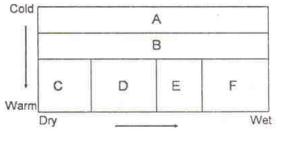
- Which one of the following terrestrial biomes is found in regions dominantly characterized by oxisols?
- Where rainfall is higher, the grassland biome steppe grades into


