
For the network given below, what are the Norton's current and Thévenin's voltage at the terminals a and b?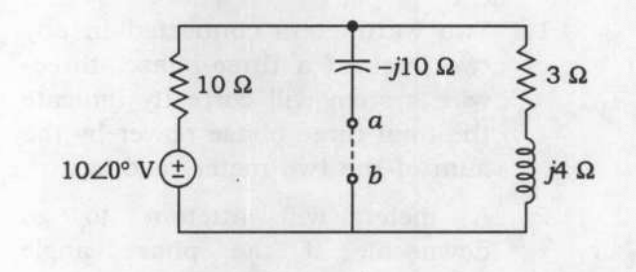
$I_{ab} = [\frac{10\angle 0^\circ}{10 + \frac{(-j10)(3+j4)}{3-j6}}] (\frac{3+j4}{3-j6}) \text{ A}$ and $V_{ab} = \frac{3+j4}{13+j4} (10\angle 0^\circ) \text{ V}$
To find Norton's current and Thévenin's voltage across terminals a and b, let us first understand the circuit given in the image.
We have the following elements in the circuit:
- A voltage source of \(10 \angle 0^\circ \text{ V}\)
- Resistances and reactances as follows:
- \(10 \, \Omega\) (left branch)
- \(-j10 \, \Omega\) (capacitive reactance)
- \(3 \, \Omega\) (right branch)
- \(j4 \, \Omega\) (inductive reactance)
Step 1: Calculate Equivalent Impedance
Calculate the equivalent impedance of the right branch (consisting of \(3 \, \Omega\) and \(j4 \, \Omega\)):
\(Z_1 = 3 + j4\)
Step 2: Calculate Total Impedance in Series
The impedance \(-j10 \, \Omega\) is in parallel with \(Z_1\) (right branch):
\(Z_{\text{parallel}} = \frac{(-j10)(3+j4)}{3+j4}\)
Total impedance \(Z_{\text{total}}\) is:
\(Z_{\text{total}} = 10 + Z_{\text{parallel}}\)
Step 3: Calculate Norton's Current
Norton's current \(I_{ab}\) is given by:
\(I_{ab} = \frac{10\angle 0^\circ}{Z_{\text{total}}} \cdot \frac{3+j4}{3-j6}\)
Step 4: Calculate Thévenin's Voltage
Calculate the open-circuit voltage at terminals a and b, \(V_{ab}\):
\(V_{ab} = \frac{3+j4}{13+j4} \cdot 10\angle 0^\circ\)
Conclusion:
The correct option is:
$I_{ab} = \left[\frac{10\angle 0^\circ}{10 + \frac{(-j10)(3+j4)}{3-j6}}\right] \left(\frac{3+j4}{3-j6}\right) \text{ A}$ and $V_{ab} = \frac{3+j4}{13+j4} (10\angle 0^\circ) \text{ V}$
Important Questions from Network Theorems
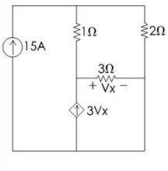
The power supplied by the dependent source in the figure is,
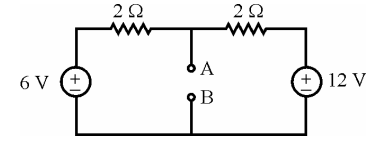
The Thevenin's equivalent across AB is
Which equivalent circuits are dual ?
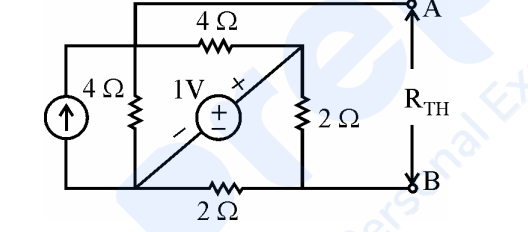
For the n/w, find RTH
The principle of superposition is the property of


