
For opaque surfaces, transmissivity is equal to ________.
0
Understanding Transmissivity of Opaque Surfaces
The question asks about the transmissivity of opaque surfaces. To answer this, we need to understand what an opaque surface is and what transmissivity means.
What is an Opaque Surface?
An opaque surface or material is one that does not allow electromagnetic radiation, such as light, to pass through it. When radiation strikes an opaque surface, it is either absorbed by the surface or reflected off it.
What is Transmissivity?
Transmissivity ($\tau$) is a property of a material that describes the fraction of incident electromagnetic radiation that passes through it. It is a value between 0 and 1 (or 0% and 100%).
- A transmissivity of 1 means all radiation passes through.
- A transmissivity of 0 means no radiation passes through.
Transmissivity of Opaque Surfaces
Since an opaque surface, by definition, does not allow any radiation to pass through, the fraction of radiation transmitted through it is zero.
Therefore, the transmissivity of an opaque surface is always $\tau = 0$.
Relationship between Radiative Properties
For any surface, the incident radiation is either absorbed, reflected, or transmitted. These fractions are represented by absorptivity ($\alpha$), reflectivity ($\rho$), and transmissivity ($\tau$), respectively. These properties are related by the equation:
\begin{equation*} \alpha + \rho + \tau = 1 \end{equation*}
For an opaque surface, we know that $\tau = 0$. The equation then simplifies to:
\begin{equation*} \alpha + \rho = 1 \end{equation*}
This shows that for an opaque surface, the incident radiation is only absorbed or reflected.
Analyzing the Options
Let's look at the given options for the transmissivity of opaque surfaces:
- 100: This implies 100% transmission, which is incorrect for an opaque surface.
- 0: This implies 0% transmission, which is correct for an opaque surface.
- 10: This implies 10% transmission, which is incorrect for an opaque surface.
- 1: In the context of fractions (0 to 1), this would mean 100% transmission, which is incorrect.
Based on the definition and properties of opaque surfaces, their transmissivity is zero.
The correct answer is 0.
Important Questions from Radiation
- A body is placed inside a perfectly black enclosure and is allowed to reach thermal equilibrium. According to the Kirchhoff’s identity, which one of the following is equal to the emissivity of the body at a given wavelength?
Thermal radiation takes place at a surface which has reflectivity of 0.55 and a transmissivity of 0.032. What is the value of absorptivity?
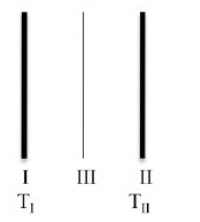
Two infinitely large parallel plates (I and II) are held at temperatures $T_I$ and $T_{II}$ ($T_I > T_{II}$) respectively, and placed at a distance $2d$ apart in vacuum. An infinitely large flat radiation shield (III) is placed in parallel in between I and II. The emissivities of all the plates are equal. The ratio of the steady state radiative heat fluxes with and without the shield is:
- Two very large parallel walls (gray bodies) facing each other have emissivities of 0.5 and 0.7. The view factor between these two walls is ________.
- The space between two hollow concentric spheres of radii 0.1 m and 0.2 m is under vacuum.
Exchange of radiation (uniform in all directions) occurs only between the outer surface ($S_1$) of the smaller sphere and the inner surface ($S_2$) of the larger sphere. The fraction (rounded off to the second decimal place) of the radiation energy leaving $S_2$, which reaches $S_1$ is


