
For fourier series of wave shown in Figure below, Select correct expression for f(t)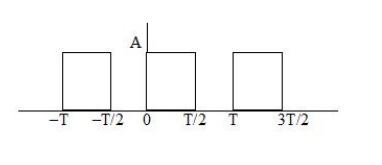
\(f(t)=\frac{A}{2}+\frac{2A}{\pi}\left[\sin(\omega_o t)+\frac{1}{3}\sin(\sin 3\omega_o t)+ \ldots \right]\)
The given problem involves finding the Fourier series for a periodic wave shown in the figure. To determine the correct expression for \( f(t) \), let's analyze the waveform and derive its Fourier series.
The waveform depicted is a square wave, which is periodic with period \( T \). The fundamental frequency is \( \omega_o = \frac{2\pi}{T} \). The Fourier series expression for a square wave is generally given as:
\(f(t) = \frac{A}{2} + \frac{2A}{\pi} \left[\sin(\omega_o t) + \frac{1}{3}\sin(3\omega_o t) + \frac{1}{5}\sin(5\omega_o t) + \ldots \right]\)
This series consists only of odd harmonics (i.e., terms like \(\sin(\omega_o t)\), \(\sin(3\omega_o t)\), etc.), which is typical for a square wave.
Now, let's compare the derived expression with the given options:
- Option 1: \(f(t)=\frac{A}{2}+\frac{2A}{\pi}\left[\sin(\omega_o t)+\frac{1}{3}\sin(\sin 3\omega_o t)+ \ldots \right]\)
- Option 2: \(f(t)=A+\frac{2A}{\pi}\left[\sin(\omega_o t)+\frac{1}{3}\sin(3\omega_o t)+ \ldots \right]\)
- Option 3: \(f(t)=\frac{A}{4}+\frac{A}{\pi}\left[\sin(\omega_o t)+\frac{1}{3}\sin(3\omega_o t)+ \ldots \right]\)
- Option 4: \(f(t)=A/2+\frac{2A}{\pi}\left[\sin(\omega_o t)+\frac{1}{3}\sin(2\omega_o t)+ \ldots \right]\)
Upon inspection, Option 1 is incorrect due to the erroneous structure \(\sin(\sin 3\omega_o t)\). Option 2 does not have the correct DC term. Option 3 scales the DC term incorrectly, and Option 4 includes even harmonics, which are not present in the square wave Fourier series.
Therefore, the correct expression is:
\(f(t) = \frac{A}{2} + \frac{2A}{\pi} \left[\sin(\omega_o t) + \frac{1}{3}\sin(3\omega_o t) + \ldots \right]\)
Important Questions from Fourier Series
If we use the Fourier transform ϕ(x, y) = \(\int {{{\rm{e}}^{{\rm{ikx}}}}} {ϕ _{\rm{k}}}\left( {\rm{y}} \right){\rm{dk}}\) to solve the partial differential equation \({\rm{ - }}\frac{{{\partial ^2}ϕ \left( {x,y} \right)}}{{\partial {y^2}}}\, - \,\frac{1}{{{y^2}}}\frac{{{\partial ^2}ϕ \left( {x,y} \right)}}{{\partial {x^2}}} + \frac{{{m^2}}}{{{y^2}}}ϕ \left( {x,y} \right) = 0\) in the half-plane {(x, y) : -∞ < x < ∞, 0 < y < ∞} the Fourier modes ϕ k(y) depend on y as y α and y β . The values of α and β are
When a time-domain signal is converted into its Fourier representation, which of the following is/are conserved?
I. Energy
II. Power
The trigonometric Fourier series of a periodic time function can have
The discrete-time Fourier series representation of a signal x[n] with period N is written as \(\rm x[n] = \sum_{k = 0}^{N - 1} a_k e^{j(2kn\pi/N)}\). A discrete-time periodic signal with period N = 3, has the non-zero Fourier series coefficients: a- 3 = 2 and a4 = 1. The signal is
let g(x) be a function defined by g(x) = x - [x], where [x] represents the integer part of x. (That is, it is the largest integer which is less than or equal to x). The value of the constant term in the Fourier series expansion of g(x) is ______.



