
Fermi Level Dependence on Effective Masses
In an intrinsic semiconductor, the Fermi level ($E_F$) is the energy level with a 50% probability of occupancy by an electron. At absolute zero temperature ($T=0$ K), it lies midway between the valence band edge ($E_v$) and the conduction band edge ($E_c$).
Temperature Effect on Fermi Level
At a finite temperature ($T > 0$ K), the Fermi level's position is determined by the balance between electron and hole concentrations. For the semiconductor to remain electrically neutral and intrinsic, the number of electrons in the conduction band ($n$) must equal the number of holes in the valence band ($p$).
$ n = p $Role of Effective Masses
The electron and hole concentrations depend on the density of states in the conduction band ($g_c(E)$) and valence band ($g_v(E)$), respectively, and the Fermi-Dirac distribution function. The densities of states are directly related to the effective masses:
- Electron density of states: $g_c(E) \propto (m_e^*)^{3/2}$
- Hole density of states: $g_v(E) \propto (m_h^*)^{3/2}$
The calculation of electron concentration ($n$) involves integrating $g_c(E)$ weighted by the Fermi-Dirac distribution function from the conduction band edge ($E_c$) upwards. Similarly, hole concentration ($p$) involves integrating $g_v(E)$ weighted by $(1 - f(E))$ from the valence band edge ($E_v$) downwards.
Mathematical Formulation
The approximate expressions for electron and hole concentrations at finite temperatures are:
$ n \approx N_c \exp\left(-\frac{E_c - E_F}{k_B T}\right) $ $ p \approx N_v \exp\left(-\frac{E_F - E_v}{k_B T}\right) $where $N_c$ and $N_v$ are the effective densities of states in the conduction and valence bands, respectively. Crucially, $N_c \propto (m_e^*)^{3/2}$ and $N_v \propto (m_h^*)^{3/2}$.
Conclusion
Setting $n=p$ and solving for $E_F$ yields:
$ E_F = \frac{E_c + E_v}{2} + \frac{3}{4} k_B T \ln\left(\frac{m_h^*}{m_e^*}\right) $This equation clearly shows that the position of the Fermi level ($E_F$) at a finite temperature depends explicitly on both the electron effective mass ($m_e^*$) and the hole effective mass ($m_h^*$).
Important Questions from Band Theory Effective Mass Holes
- For the energy dispersion of an electron in a one-dimensional solid $E(k) = E_0 - 2\gamma \cos(ka)$, the ratio of the effective mass of the electron in the solid to the free electron mass ($m_e$) at $k = 0$ is $R_0$. Taking $\gamma = 0.5 \text{ eV}$ and $a = 0.5 \text{ nm}$, the value of $R_0$ (rounded off to two decimal place) is _____
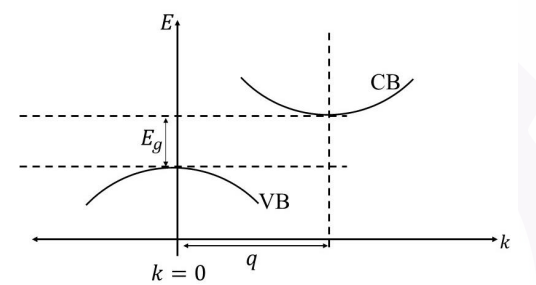
($\hbar = 1.054 \times 10^{-34} \text{ J.s}$, $m_e = 9.1 \times 10^{-31} \text{ kg}$, electron charge $= 1.6 \times 10^{-19} \text{ C}$) The dispersion ($E(k)$) of the conduction band (CB) and valence band (VB) for a semiconductor are shown schematically in the figure. Considering the possibility of an electron making a transition from the bottom of the CB to the top of the VB, which of the following options is/are correct?
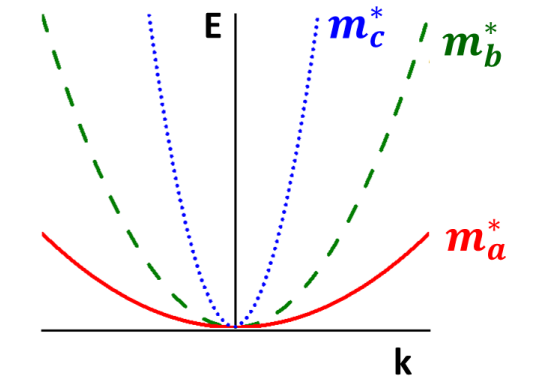
For nonrelativistic electrons in a solid, different energy dispersion relations (with effective masses $m_a^*$, $m_b^*$, and $m_c^*$) are schematically shown in the plots. Which one of the following options is CORRECT?
The temperature dependence of the electrical conductivity ($\sigma$) of three intrinsic semiconductors A, B and C is shown in figure.
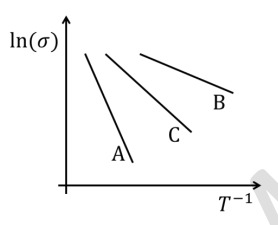
Let $E_A$, $E_B$ and $E_C$ be the bandgaps of A, B and C, respectively. Which one of the following relations is correct?- The energy dispersion for electrons in one dimensional lattice with lattice parameter $a$ is given by $E(k) = E_0 - \frac{1}{2} W \cos ka$, where $W$ and $E_0$ are constants. The effective mass of the electron near the bottom of the band is


