
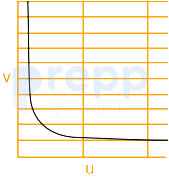
For a human eye, where u is the distance of an object from the eye, f is the focal length of the lens and v is the distance of image from the eye, which is the correct schematic graph?
Given:
For a human eye, where u is the distance of an object from the eye, f is the focal length of the lens, and v is the distance of the image from the eye.
Concept Used:
The lens formula for a thin lens is given by:
1/f = 1/v + 1/u
Where:
- u is the object distance (measured from the lens)
- v is the image distance (measured from the lens)
- f is the focal length of the lens
Calculation:
We need to plot the graph based on the lens formula:
⇒ If we rearrange the lens formula, we get:
1/v = 1/f - 1/u
⇒ As u changes, v will change accordingly to satisfy the lens formula. The relationship between u and v is hyperbolic.
Let's consider a few cases:
⇒ When u = ∞ (object is at infinity),
1/v = 1/f - 0
v = f
⇒ When u = f (object is at the focal length),
1/v = 1/f - 1/f
v = ∞
⇒ When u < f (object is between the lens and the focal point),
v is negative indicating a virtual image.
Based on this, the correct schematic graph is option 1, which shows the hyperbolic relationship between u and v.
∴ The correct answer is option 1.
Similar Questions
The human eye is like a camera that has a lens with:
A microscope may be a combination of:
Which of the following statements with regard to the phenomenon of the primary rainbow formation by water droplets is/are correct?
1. It involves refraction and one internal reflection of sunlight.
2. It involves refraction of sunlight only.
3. It is formed as the inner bow.
4. It may involve more than one internal reflection as well as refraction of sunlight.
Select the answer using the code given below:
- The twinkling of a star is due to the atmospheric
- What is the magnification produced by a concave lens of focal length 10 cm, when an image is formed at a distance of 5 cm from the lens?
Two convex lenses have focal lengths of 50 cm and 25 cm, respectively. If these two lenses are placed in contact, then the net power of this combination will be equal to
Mirage is an illustration of
Twinkling of stars is due to
Tyndall effect is a phenomenon of
Twinkling of stars is primarily due to the atmospheric
Important Questions from Refraction and Reflection
Which of the following is NOT an example of refraction of light?
If the object distance and the image distance from a concave mirror is -20 cm, what is the focal length of the mirror?
Water drops shine on a lotus leaf due to:
A convex lens 'A' of focal length $10 \text{ cm}$ and another convex lens 'B' of focal length $20 \text{ cm}$ are kept along the same axis with a distance '$d$' between them. If a parallel beam of light falling on 'A' leaves 'B' as a parallel beam, then the distance '$d$' in $cm$ will be :
- A ray is incident at an angle of incidence $i$ on one surface of a small angle prism (with angle of prism $A$ and refractive index $\mu$). The ray emerges normally from the opposite surface, causing a total angle of deviation $\delta$ from its original path. Assuming all angles are small, the angle of incidence $i$ is nearly equal to:



