
Fly larvae of a species feed simultaneously on a shared rotting fruit. If the density of fly larvae is high, then all the larvae grow up to be smaller sized adults than if the larval density were low. Which one of the following processes best describes this observation?
Scramble Competition Dynamics Explained
The scenario describes fly larvae feeding on a shared, limited resource (rotting fruit). When the number of larvae (density) is high, they must share the resource more intensely. This situation, where individuals directly consume or deplete a shared resource, and reduced availability affects all individuals, is termed scramble competition.
In high-density conditions, the shared resource gets divided among many individuals, resulting in each larva receiving insufficient nutrition. This lack of adequate resources directly hinders their growth, leading to smaller adult sizes compared to larvae in low-density environments where resources are more abundant per individual.
Analyzing Competition Types
- Interspecific competition refers to competition between individuals of *different* species. This question focuses on competition *within* a single species ('fly larvae of a species'), making interspecific competition incorrect.
- Competitive exclusion describes the principle that two species competing for the same limiting resources cannot coexist indefinitely; one eliminates the other. This concept usually applies to interactions between different species and their coexistence, not the impact of density on individual growth within one species.
- Apparent competition occurs indirectly, for instance, when a shared predator boosts the populations of two prey species, increasing competition between them. It does not involve the direct depletion of a resource by numerous individuals affecting their own growth, as described in the question.
Important Questions from Competition
- Ecologists have studied the distributions of birds on archipelagos. Some studies found an interesting 'checkerboard' pattern within island groups. Sister species were never present on the same island, even when the islands were very close to each other. Which one of the following processes best explains this checkerboard pattern?
- Two bird species, A and B, are found on a single mountainside. A is a low-elevation species, found between 500 m and 1500 m Above Sea Level (ASL), while B is a high-elevation species, found between 1000 m and 2000 m ASL. At 1250 m ASL, species A and B have very different bill morphologies, but the bill morphology of species A at 500 m is very similar to the bill morphology of species B at 2000 m ASL. Which one or more of the following explain(s) the difference in bill morphology at 1250 m ASL?
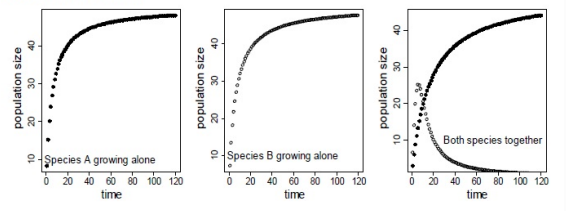
The figure panels below show population growth in two species (solid circles and open circles), when they are grown alone, and when they are grown together. The interaction between these species is an example of
- In an assemblage of coexisting wild cat species, the size of canine teeth was found to be strikingly different between these species. Which one or more of the following statements explain(s) this observation?
The barnacle species, Chthamalus stellatus (CS), is found only in the high intertidal zone whereas Balanus glandula (BG) is found only in the low intertidal zone. A researcher transplanted CS from the high to low (T-CS), and BG from the low to high (T-BG) intertidal zones. Additionally, they allowed the species to grow alone or in competition with each other, and quantified survival.
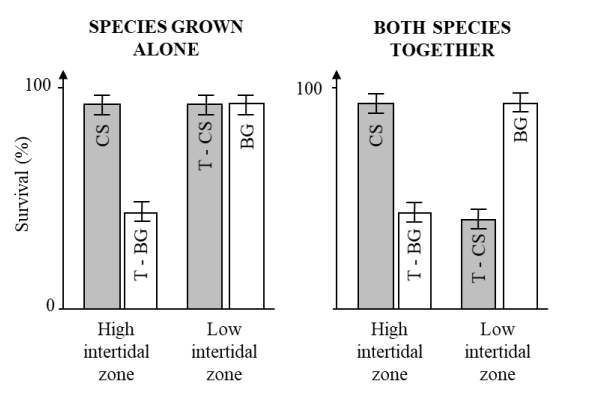
Which one or more of the following inferences is/are consistent with the experimental results shown below?


