
Question
Find the least upper bound and greatest lower bound of $S=\{X,Y,Z\}$ if they exist, of the poset whose Hasse diagram is shown below: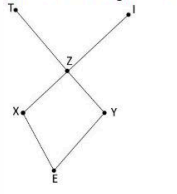
The correct answer is
The least upper bound is Z and the greatest lower bound is E.
To find the least upper bound (LUB) and greatest lower bound (GLB) of the set \(S = \{X, Y, Z\}\) in the given poset from the Hasse diagram:
- Understanding the Poset:
- The diagram shows a partially ordered set (poset) with elements connected by lines indicating order.
- \(E\) is the minimal element and \(T, I\) are the topmost elements.
- Greatest Lower Bound (GLB):
- The GLB of a set is the greatest element that is less than or equal to every element of the set in the poset.
- For \(S = \{X, Y, Z\}\), the elements that are directly below any element in \(S\) should be considered.
- \(E\) is below both \(X\) and \(Y\), and is the lowest point where it reaches all elements in \(S\).
- Thus, the GLB of \(S\) is \(E\).
- Least Upper Bound (LUB):
- The LUB of a set is the least element that is greater than or equal to every element of the set in the poset.
- For \(S = \{X, Y, Z\}\), the elements that are directly above any element in \(S\) should be considered.
- \(Z\) is above both \(X\) and \(Y\) and encapsulates \(Z\) itself as well.
- Thus, the LUB of \(S\) is \(Z\).
Therefore, the least upper bound is \(Z\) and the greatest lower bound is \(E\).
Was this answer helpful?
Important Questions from Set Theory and Venn Diagram (Notes)
A student is free to choose only Chemistry, only Biology or both. If out of $32$ students, Chemistry has been chosen by $16$ and Biology by $25$, then how many students have chosen Biology but not Chemistry?
- Fourteen of the students in a class are girls. Eight students in the class wear blue shirts. Two are neither girls nor wear blue shirts. Five students who wear blue shirts are girls. How many students are there in the class?
- In a group of 44 players, 26 play hockey, 24 play football and 24 play cricket. Eight of them play both hockey and football, 12 play both football and cricket, and 5 play all the three games. How many play both hockey and cricket?
- In a group of students, 30% play only cricket, 20% play only football and 10% play only basketball. 20% of the students play both football and cricket, 15% play both basketball and cricket, 10% play both football and basketball. 15 students play no games, while 5% of the students play all three games. What is the total number of students?
- Which of the following statements are true ?
A. Set A = {x : x $\in$ R and 2 < x < 3} is a null set.
B. Set A = {x : x $\in$ R and 2 < x < 4} is a singleton set.
C. Set A = {x : x $\in$ R and 1 < x < 9} is an infinite set.
D. Set A = {x : x $\in$ R and 1 < x < 9} is a finite set.
E. Set A = {a, b, c, d, e} and B = {c, d, a, e, b} are equal sets.
Choose the correct answer from the options given below :
Need Expert Advice?


