Different Term Identification
The goal of this question is to identify which number in the list does not share a common mathematical property with the others. This requires analyzing the properties of each given number.
Number Options Analysis
The options provided are:
- Option 1: 49
- Option 2: 64
- Option 3: 90
- Option 4: 81
We will look for a pattern among these numbers.
Perfect Squares Pattern
A common pattern in such questions is whether the numbers are perfect squares. A perfect square is a number that results from multiplying an integer by itself.
- 49: This number can be obtained by squaring the integer 7. Calculation: \(49 = 7 \times 7 = 7^2\). So, 49 is a perfect square.
- 64: This number can be obtained by squaring the integer 8. Calculation: \(64 = 8 \times 8 = 8^2\). So, 64 is a perfect square.
- 81: This number can be obtained by squaring the integer 9. Calculation: \(81 = 9 \times 9 = 9^2\). So, 81 is a perfect square.
Outlier: Number 90
Now, let's check the number 90 for the same property:
We need to determine if 90 is a perfect square.
- Consider the squares of integers near the square root of 90.
- We know that \(9^2 = 81\).
- The next integer square is \(10^2 = 100\).
- Since 90 falls between 81 and 100, it cannot be represented as the square of an integer (\(n^2\)).
- Therefore, 90 is not a perfect square.
Term Conclusion
By analyzing the options, we found that 49, 64, and 81 are all perfect squares. The number 90 does not fit this pattern because it is not a perfect square. Consequently, 90 is the different term in the list.
Similar Questions
- Apple, Banana, Carrot, Mango - which is the odd one?
Choose the figure which is different from the rest?
Among the given figures, identify the one that does not belong to the group based on the pattern.
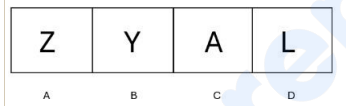
Three of the following four are alike in a certain way and thus form a group. Which is the one that does NOT belong to that group?
Three of the following four letter-clusters are alike in a certain way and one is different. Pick the odd one out.
(NOTE: The odd one out is not based on the number of vowels or consonants in the word)
Three of the following four letter-clusters are alike in a certain way and one is different. Pick the odd one out.
(NOTE: The odd one out is not based on the number of vowels or consonants in the word)
Three of the following four letter-clusters are alike in a certain way and one is different. Pick the odd one out.
(NOTE: The odd one out is not based on the number of vowels or consonants in the word)
- Four of the following five are alike in a certain way and hence form a group. Which is the one that does not belong to that group?
A. FHJL
B. KMOQ
C. PRTV
D. ACED
E. WYAC - Find the number that doesn't belong:
Three of the following four are alike in a certain way and thus form a group. Which is the one that does NOT belong to that group?
(NOTE: The odd one out is not based on the number of vowels or consonants in the word)
Important Questions from Classification
Directions for the following 3 (three) items : consider the given information and answer the three items that follow.
A, B, C, D, E, F and G are Lecturers from different cities—Hyderabad, Delhi, Shillong, Kanpur, Chennai, Mumbai and Srinagar (not necessarily in the same order) who participated in a conference. Each one of them is specialized in a different subject, viz., Economics, Commerce, History, Sociology, Geography, Mathematics and Statistics (not necessarily in the same order).
Further 1. Lecturer from Kanpur is specialized in Geography
2. Lecturer D is from Shillong
3. Lecturer C from Delhi is specialized in Sociology
4. Lecturer B is specialized in neither History nor Mathematics
5. Lecturer A who is specialized in Economics does not belong to Hyderabad
6. Lecturer F who is specialized in Commerce belongs to Srinagar
7. Lecturer G who is specialized in Statistics belongs to Chennai
Who is specialized in Geography?
A, B, C, D, E, F and G are Lecturers from different cities—Hyderabad, Delhi, Shillong, Kanpur, Chennai, Mumbai and Srinagar (not necessarily in the same order) who participated in a conference. Each one of them is specialized in a different subject, viz., Economics, Commerce, History, Sociology, Geography, Mathematics and Statistics (not necessarily in the same order).
Further 1. Lecturer from Kanpur is specialized in Geography
2. Lecturer D is from Shillong
3. Lecturer C from Delhi is specialized in Sociology
4. Lecturer B is specialized in neither History nor Mathematics
5. Lecturer A who is specialized in Economics does not belong to Hyderabad
6. Lecturer F who is specialized in Commerce belongs to Srinagar
7. Lecturer G who is specialized in Statistics belongs to Chennai
To which city does the Lecturer specialized in Economics belong?
A, B, C, D, E, F and G are Lecturers from different cities—Hyderabad, Delhi, Shillong, Kanpur, Chennai, Mumbai and Srinagar (not necessarily in the same order) who participated in a conference. Each one of them is specialized in a different subject, viz., Economics, Commerce, History, Sociology, Geography, Mathematics and Statistics (not necessarily in the same order).
Further 1. Lecturer from Kanpur is specialized in Geography
2. Lecturer D is from Shillong
3. Lecturer C from Delhi is specialized in Sociology
4. Lecturer B is specialized in neither History nor Mathematics
5. Lecturer A who is specialized in Economics does not belong to Hyderabad
6. Lecturer F who is specialized in Commerce belongs to Srinagar
7. Lecturer G who is specialized in Statistics belongs to Chennai
Who of the following belongs to Hyderabad?
In a school, there are five teachers A, B, C, D and E. A and B teach Hindi and English. C and B teach English and Geography. D and A teach Mathematics and Hindi. E and B teach History and French. Who teaches maximum numb, of subjects?
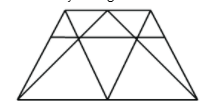
How many triangles are there in the given figure?