
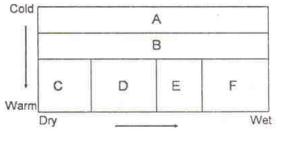
Availability of soil water and Heat Biomes A Insufficient heat I Forest B Moderate shortage of soil water, adequate heat II Desert C Extreme shortage of soil water, adequate heat III Grassland D Ample soil water and heat IV Tundra
The question requires matching environmental conditions (soil water and heat) with specific biomes. We can determine the correct pairings by considering the defining characteristics of each biome.
Biome Matching Strategy
We need to match the conditions A, B, C, and D with the biomes I, II, III, and IV based on the descriptions provided.
Analyzing Conditions and Biomes
Condition A: Insufficient heat
This condition directly points to biomes with very low temperatures. The Tundra biome (IV) is characterized by extremely cold temperatures and a short growing season, fitting this description.
Match: A - IV (Tundra)
Condition D: Ample soil water and heat
This describes environments that support lush vegetation growth. Forests (I), particularly temperate and tropical forests, typically receive ample rainfall and warmth, allowing for dense tree cover.
Match: D - I (Forest)
Condition C: Extreme shortage of soil water, adequate heat
This is a defining characteristic of arid environments. Deserts (II) are known for very low precipitation levels (extreme water shortage) and often high temperatures (adequate heat).
Match: C - II (Desert)
Condition B: Moderate shortage of soil water, adequate heat
This condition describes biomes that are not as dry as deserts but experience less water availability than forests, often with seasonal dry periods. Grasslands (III) fit this profile, experiencing moderate rainfall and adequate heat, supporting grasses over trees.
Match: B - III (Grassland)
Correct Matching Summary
- A (Insufficient heat) matches with IV (Tundra).
- B (Moderate shortage of soil water, adequate heat) matches with III (Grassland).
- C (Extreme shortage of soil water, adequate heat) matches with II (Desert).
- D (Ample soil water and heat) matches with I (Forest).
Therefore, the correct combination is A-IV, B-III, C-II, D-I.
Important Questions from Bio-Geography
- Ecological succession in the upwelling region of the Southwest coast of India can be best exemplified by
- Match the forests with their characters
Forests Characters A. Subtropical evergreen forest P. The trees are spaced widely apart B. Savanna woodland Q. Trees with small hard leathery leave C. Sclerophyll forest R. Straight trunked cone-shaped trees with relatively short branched and small, narrow needle like leaves D. Boreal forest S. Broad leaf T. Needle leaf Indentify the biomes
Match the ecological adaptive strategies with the plant types
Plant Type Adaptive strategies A. Hydrophytes E. germination of seeds before they shed; adventitious roots that develop from the base of the stem; negatively geotropic roots for supply of oxygen B. Mesophytes F. root systems are very deep; stems are dwarf and branched; stomata are less in number and generally confined to the lower surface of leaves C. Xerophytes G. leaves are thin, narrow, and linear; extensive aerenchyma in all organs; stomata are generally absent D. Halophytes H. leaves are large; stem is rigid and stout; normal physiological processes
Choose the correct option- Which one of the following terrestrial biomes is found in regions dominantly characterized by oxisols?


