
Understanding Enhanced Weathering and Cooling
Tectonic uplift plays a crucial role in the Earth's carbon cycle and climate regulation. Enhanced weathering, driven by tectonic activity, reduces atmospheric carbon dioxide ($\text{CO}_2$) levels, leading to a cooling effect.
Key Mechanism: Silicate Mineral Weathering
- Tectonic Uplift Effect: When tectonic forces cause landmasses to rise (uplift), they expose fresh rock surfaces and deeper crustal materials.
- Mineral Exposure: These newly exposed rocks, particularly those rich in silicate minerals (like feldspar and quartz), become readily available for chemical weathering.
- Chemical Weathering Process: Chemical weathering involves reactions between rock minerals and elements in rainwater and atmospheric gases. The weathering of silicate minerals consumes atmospheric $\text{CO}_2$. A simplified representation of this reaction is: $\text{CaSiO}_3 \text{ (silicate)} + 2\text{CO}_2 + \text{H}_2\text{O} \rightarrow \text{Ca}^{2+} + 2\text{HCO}_3^{-} + \text{SiO}_2$
- CO2 Reduction: This process effectively removes $\text{CO}_2$ from the atmosphere, converting it into bicarbonate ions ($\text{HCO}_3^{-}$) which are eventually transported to the oceans.
- Cooling Induction: The reduction in atmospheric $\text{CO}_2$, a greenhouse gas, leads to less heat being trapped, resulting in global cooling.
Why Other Options Are Less Direct
- Orographic Barriers: While uplift creates mountains affecting air circulation, this is not the primary driver of $\text{CO}_2$ reduction via weathering.
- Precipitation & Runoff: These factors enhance weathering but are consequences or facilitators, not the core process removing $\text{CO}_2$.
- Valley Erosion: Deeper erosion is a result of geological processes, not the direct cause of $\text{CO}_2$ consumption.
Therefore, the continual exposure of fresh silicate minerals to chemical weathering is the direct cause of $\text{CO}_2$ reduction and subsequent cooling linked to tectonic uplift.
Important Questions from Weathering
- Bauxite formation is an example of metal enrichment by extreme
- Silcretes or silica-rich duricrusts generally form under
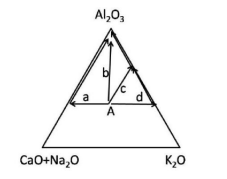
During normal weathering of a granite rock (A), clay minerals and then residue of gibbsite are formed. Which one is the correct weathering path for the rock in the given diagram ($\text{Al}_2\text{O}_3$, $\text{CaO}$, $\text{Na}_2\text{O}$ and $\text{K}_2\text{O}$ are in moles).
- During spheroidal weathering, a block of rock converts to a spheroid due to
- Which type(s) of chemical reactions occur(s) during the weathering of pyroxene?


