
Enzyme Catalyzed Reaction Equilibrium Constant
Enzymes act as biological catalysts. Catalysts accelerate the rate of a chemical reaction by lowering the activation energy, allowing the reaction to reach equilibrium faster.
However, a crucial point about catalysts, including enzymes, is that they do not alter the position of the chemical equilibrium itself. They affect the kinetics (how fast the reaction proceeds) but not the thermodynamics (the final state of equilibrium).
- Enzymes increase the reaction rate by providing an alternative reaction pathway with lower activation energy.
- They speed up both the forward and reverse reactions equally.
- Therefore, the equilibrium constant ($K_{eq}$), which is the ratio of product concentrations to reactant concentrations at equilibrium, remains unchanged.
The equilibrium constant ($K_{eq}$) depends only on temperature and the specific reactants and products involved, not on the presence or absence of a catalyst.
Thus, for an enzyme catalyzed reaction, the equilibrium constant remains unchanged.
Important Questions from Enzyme Kinetics Michaelis Menten K_m V_{max}
- An enzyme following Michaelis-Menten kinetics, catalyses a reaction with an initial velocity ($V_0$) of $2\ \mu\text{M s}^{-1}$ at the substrate concentration of $10\ \mu\text{M}$. If the turnover number ($k_{\text{cat}}$) of the enzyme for the given substrate is $500\ \text{s}^{-1}$ and the enzyme concentration in the reaction is $0.01\ \mu\text{M}$, then the value of the Michaelis-Menten constant ($K_m$) would be__________ $\times\ 10^{-6}\ \text{M}$ (in integer).
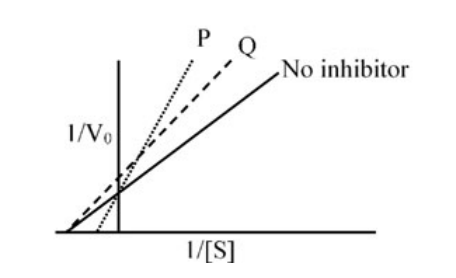
The graph below shows the activity of enzyme pepsin in the presence of inhibitors aliphatic alcohols (P) or N-acetyl-1-phenylalanine (Q). Which ONE of the following represents the nature of inhibition by P and Q, respectively?
The following plot represents the Lineweaver-Burk equation of an enzymatic reaction both in the presence and the absence of inhibitor. Here, V is the velocity of reaction and S is the substrate concentration.
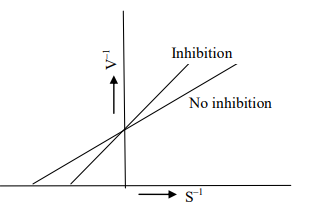
The nature of inhibition shown in the plot is
- For an enzyme catalyzed reaction, the plot that correctly represents the relationship between the rate and temperature is
- In an enzyme catalyzed reaction, the initial reaction velocity is only one fourth of its maximum velocity. If the substrate concentration is $3.0 \times 10^{-3}$ mM, the value of $K_m$ in micro molar ($\mu$M) will be ....


