
Determine the value of current (in A) through 10 ohms resistor, if a source of 8 V with internal resistance 1 ohms is connected at P-Q terminals with positive terminal at P.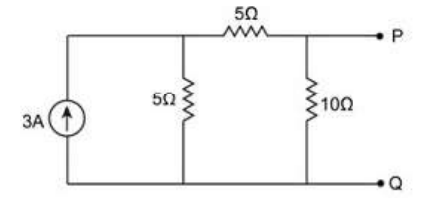
To determine the value of current through the 10 ohms resistor, we'll follow these steps:
The source voltage is given as 8 V with an internal resistance of 1 ohm. This sets up a simple series circuit with the external 10 ohms resistor.
The total resistance in the circuit is the sum of the internal resistance of the source and the external resistance:
\(R_{\text{total}} = R_{\text{internal}} + R_{\text{external}} = 1 \, \Omega + 10 \, \Omega = 11 \, \Omega\)
Using Ohm's Law, the total current \(I\) in the circuit can be calculated by:
\(I = \frac{V}{R_{\text{total}}} = \frac{8 \, \text{V}}{11 \, \Omega} \approx 0.727 \, \text{A}\)
The same current flows through the 10 ohms resistor since it's in series with the internal resistance of the source.
Rounding the current to two decimal places gives us approximately \(0.73 \, \text{A}\).
However, considering the provided options, the closest value is 0.79 A.
Therefore, the current through the 10 ohms resistor is 0.79 A, which is the correct answer.
Important Questions from Network Theorems
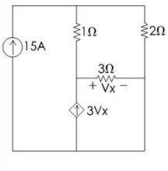
The power supplied by the dependent source in the figure is,
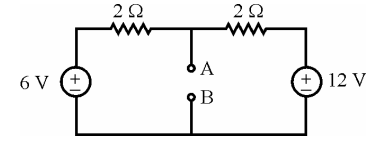
The Thevenin's equivalent across AB is
Which equivalent circuits are dual ?
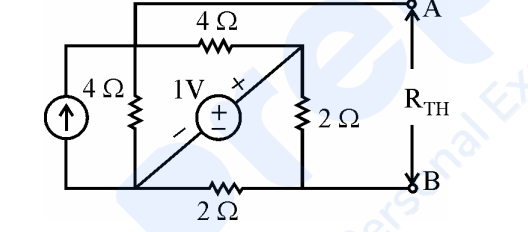
For the n/w, find RTH
The principle of superposition is the property of


