
Determine the correctness or otherwise of the following Assertion (a) and Reason (r). Assertion (a): Peak aging time for an Al-4 wt.% Cu alloy is indicated by a maximum in the hardness. Reason (r): The maximum volume fraction of the $\theta$ precipitates is formed at the peak aging time.
Assertion (a) Analysis: Peak Aging and Hardness in Al-4%Cu
Assertion (a) states that the peak aging time for an Al-4 wt.% Cu alloy is indicated by a maximum in hardness. This statement is true. During age hardening, the alloy's hardness increases as fine precipitates form and grow, impeding dislocation movement. Hardness peaks at the optimal precipitate structure (peak aging) before declining due to precipitate coarsening (overaging).
Reason (r) Analysis: Precipitate Volume Fraction at Peak Aging
Reason (r) claims that the maximum volume fraction of the $\theta$ precipitates forms at peak aging time. This statement is false.
- Peak aging in Al-Cu alloys corresponds to the optimal size, distribution, and coherency of *metastable* precipitates (like $\theta''$ or $\theta'$) that provide maximum strengthening.
- The equilibrium $\theta$ phase (Al$_2$Cu) precipitate typically forms and grows significantly during the *overaging* stage, which follows peak aging.
- Maximum hardness is achieved when precipitates are fine and numerous, not necessarily when the *equilibrium* $\theta$ phase reaches its maximum volume fraction.
Conclusion: Correctness of Assertion and Reason
The analysis shows:
- Assertion (a) is true: Peak aging aligns with maximum hardness.
- Reason (r) is false: Maximum hardness occurs before the maximum volume fraction of the equilibrium $\theta$ phase forms.
Therefore, assertion (a) is true, and reason (r) is false.
Important Questions from Heat Treatment Quenching Critical Cooling Rate
- Which of the following statements is/are CORRECT when Ni is added as an alloying element to a low alloy steel?
- In a Jominy end-quench test of the eutectoid plain-carbon steel, which of the following represents the sequence of microstructures observed from the quenched end of the specimen?
- Which one of the following is the correct decreasing sequence of Quenching Power for quenchants used in heat treatment of steels?
- Which one of the following techniques does NOT require quenching to obtain final case hardness?
The microstructures of a quenched steel tempered at three temperatures $T_1 < T_2 < T_3$ for a fixed time are schematically illustrated. The solid circles represent cementite particles in ferrite matrix; $\bar{r}_1, \bar{r}_2$ and $\bar{r}_3$ are average radii of cementite particles, and $V_1, V_2$ and $V_3$ are volume fractions of cementite at temperatures $T_1, T_2$ and $T_3$, respectively.
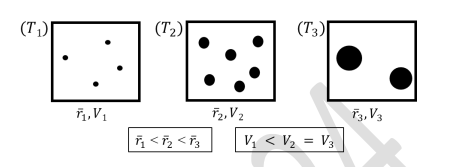
If the cementite in steel is more noble than ferrite, then which one of the three microstructures will have the highest corrosion rate when exposed to an aqueous solution of $3.5 \text{ wt.\% NaCl}$?


