
Describe the structure of chloroplast with labelled diagram and write about its functions.
The chloroplast is a crucial, oval-shaped, double-membrane-bound organelle found in plant and algal cells, the primary site of photosynthesis.
Structure:
Outer Membrane: Permeable, enclosing the organelle.
Inner Membrane: Less permeable, regulating molecule passage.
Intermembrane Space: Between the two membranes.
Stroma: Gel-like matrix filling the inner membrane, containing enzymes (e.g., RuBisCO for Calvin cycle), ribosomes, circular DNA, starch, and lipid droplets.
Thylakoids: Flattened, sac-like membranes within the stroma; site of light-dependent reactions.
Granum (plural: Grana): Stacks of 10-20 thylakoids, interconnected by stromal lamellae.
Thylakoid Lumen: Space inside the thylakoid, where the proton gradient is established.
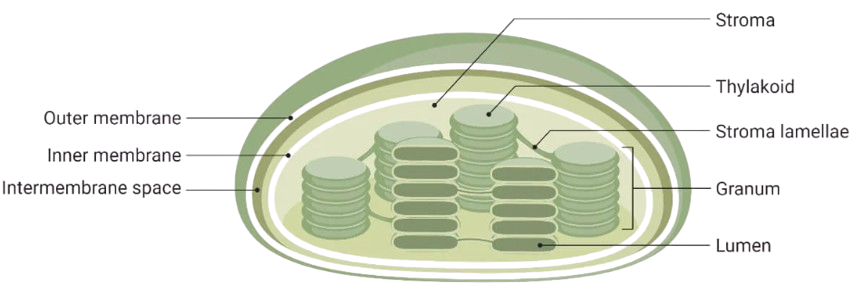
Functions:
Photosynthesis: Primary function. Converts light energy into chemical energy (ATP, NADPH), then fixes atmospheric CO2 into glucose.
Light-Dependent Reactions: On thylakoid membranes. Chlorophyll captures light, splitting water, releasing O2, and synthesizing ATP/NADPH.
Light-Independent Reactions (Calvin Cycle): In the stroma. ATP/NADPH convert CO2 into sugars.
Starch Synthesis & Storage: Synthesizes and temporarily stores starch.
Fatty Acid & Amino Acid Synthesis: Involved in synthesizing some fatty acids and amino acids.
Immune Response: Plays roles in plant defense signaling.
Its intricate, compartmentalized structure allows efficient execution of photosynthesis, vital for plant life and global ecosystems.
Answered By:
Sakshi Negi
Sakshi Negi is a Delhi-based journalist and content specialist with expertise in educational content and digital media, focusing particularly on government exam preparation and career guidance. With a degree in Journalism and Mass Communication from NRAI School of Mass Communication and her background as a Kendriya Vidyalaya alumna, she brings unique insights into the Indian education system and government sector opportunities.

Similar Questions
Write short notes in 150 words:
Nuclear pore complexWrite short notes in 150 words:
LysosomeWrite short notes in 150 words:
EpistasisWrite short notes in 150 words:
Synaptonemal complexWrite short notes in 150 words:
AmphidiploidyWhat are the different methods of DNA sequencing? Elaborate the shotgun sequencing method.
What is organic evolution? Discuss in detail the indirect evidences of organic evolution with suitable examples.
Elucidate the molecular basis of sex determination in plants. Explain the role of homomorphic and heteromorphic sex chromosomes.
What are the different gene transfer methods in plants? Give a brief account of direct gene transfer methods.
What are transgenic crops? Discuss the prospects and risks involved in their cultivation.
Important Questions from Miscellaneous
Write a note in 150 words
Mendelian and non-Mendelian traits.Write a note in 150 words
Theoretical significance of Purum kinship-system.Write a note in 150 words
Smell as a signal among non-human primates.Write a note in 150 words
Osteodontokeratik culture and its makers.Discuss the Miocene hominoid remains and their significance in evolution.



