
($h$ is the Planck's constant and $e$ is the electronic charge)
Quantization of magnetic flux in superconducting ring in the unit of $\frac{h}{e}$
BCS Theory Superconductor Analysis
The Bardeen-Cooper-Schrieffer (BCS) theory explains conventional superconductivity. It's based on the formation of Cooper pairs (electron pairs) mediated by lattice vibrations (phonons). Let's evaluate each statement concerning BCS theory:
Evaluating Superconductivity Statements
- Presence of energy gap: BCS theory successfully predicts the existence of an energy gap ($ \Delta $) at the Fermi level in superconductors below their critical temperature ($ T_c $). This gap represents the binding energy of Cooper pairs and is crucial for superconductivity. This statement is CORRECT.
- Different critical temperatures for isotopes: BCS theory explains the isotope effect, where the critical temperature ($ T_c $) of a superconductor is inversely proportional to the square root of the isotopic mass ($ M $), i.e., $ T_c \propto M^{-\alpha} $. This is because lattice vibrations, which mediate electron pairing, depend on the mass of the ions. This statement is CORRECT.
- Quantization of magnetic flux: Superconducting rings exhibit quantized magnetic flux. However, BCS theory predicts this quantization occurs in fundamental units of $ \frac{h}{2e} $, where $ h $ is Planck's constant and $ e $ is the elementary charge (related to Cooper pairs, each containing two electrons). The statement incorrectly suggests the unit is $ \frac{h}{e} $. This statement is INCORRECT.
- Presence of Meissner effect: The Meissner effect, the expulsion of magnetic fields from the interior of a superconductor, is a defining characteristic explained by BCS theory. The theory shows that currents induced on the surface perfectly cancel the external magnetic field inside. This statement is CORRECT.
Identifying the Incorrect Statement
Based on the analysis, the statement that is NOT CORRECT according to the BCS theory is the unit of magnetic flux quantization. The actual unit predicted by the theory is $ \frac{h}{2e} $, not $ \frac{h}{e} $.
Important Questions from Superconductivity Meissner Effect BCS Theory
Consider a metal-superconductor junction connected to a dc voltage $V$. At $T < T_c$, where $T_c$ is the superconductor's transition temperature, the current $I$ versus $V$ behavior of this junction is shown schematically in the figure below. If the superconducting energy gap is $D \text{ meV}$. The value of $D$ (rounded off to one decimal place) is _____
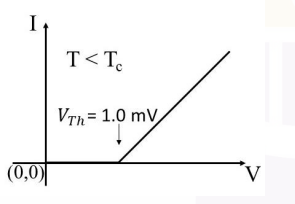
- Which of the following option(s) is/are correct for a Type I superconductor?
The figure schematically shows the $M$ (magnetization) - $H$ (magnetic field) plots for certain types of materials. Here $M$ and $H$ are plotted in the same scale and units. Which one of the following is the most appropriate combination?
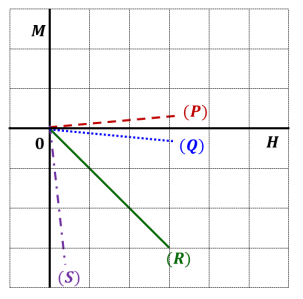
- A material behaves as a superconductor below a critical temperature $T_c$ and as a normal conductor above $T_c$. A magnetic field $\vec{B} = B\hat{z}$ is applied when $T > T_c$. The material is then cooled below $T_c$ in the presence of $\vec{B}$. Which of the following figure represent the correct configuration of magnetic field lines?
- Amongst electrical resistivity ($\rho$), thermal conductivity ($\kappa$), specific heat ($C$), Young's modulus ($Y$), and magnetic susceptibility ($\chi$), which quantities show a sharp change at the superconducting transition temperature?


