
Consider two continuous time signals $x(t)$ and $y(t)$ as shown below 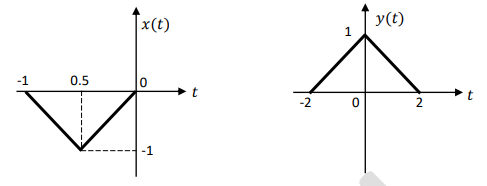
If $X(f)$ denotes the Fourier transform of $x(t)$, then the Fourier transform of $y(t)$ is _________
To find the Fourier transform of \( y(t) \) in terms of \( X(f) \), we first establish a mathematical relationship between the two signals \( x(t) \) and \( y(t) \) using time-domain transformations.
1. Relationship between \( x(t) \) and \( y(t) \)
- Amplitude Inversion: Signal \( x(t) \) has a negative peak (\(-1\)), while \( y(t) \) has a positive peak (\(1\)). This indicates a reflection across the time axis: \( -x(t) \).
- Time Scaling: The base width of \( x(t) \) is \( 1 \) unit (from \(t = -1\) to \( t = 0 \)). The base width of \( y(t) \) is \( 4 \) units (from \(t = -2\) to \( t = 2 \)). This is a time expansion by a factor of \( 4 \), achieved by replacing \( t \) with \( t/4 \).
- Time Shifting:
- The peak of \( x(t) \) is at \( t = -0.5 \).
- When we expand the time scale by \( 4 \), the peak position moves to \( t = -0.5 \times 4 = -2 \).
- To align this expanded peak with the peak of \( y(t) \) at \( t = 0 \), we must shift the signal to the right by \( 2 \) units. Replacing \( t \) with \( t - 2 \) in the scaled expression gives: $$ y(t) = -x\left( \frac{t - 2}{4} \right) $$
Verification:
- At \( t = 0 \): \( y(0) = -x(-2/4) = -x(-0.5) = -(-1) = 1 \). (Correct)
- At \( t = 2 \): \( y(2) = -x(0) = 0 \). (Correct)
- At \( t = -2 \): \( y(-2) = -x(-1) = 0 \). (Correct)
2. Applying Fourier Transform Properties
We use the following standard properties of the Fourier Transform:
- Time Scaling: If \( \mathcal{F}\{x(t)\} = X(f) \), then \( \mathcal{F}\{x(at)\} = \frac{1}{|a|} X\left( \frac{f}{a} \right) \).
- Time Shifting: If \( \mathcal{F}\{x(t)\} = X(f) \), then \( \mathcal{F}\{x(t - t_0)\} = X(f) e^{-j 2\pi f t_0} \).
Starting with \( y(t) = -x\left( \frac{1}{4}t - \frac{1}{2} \right) \), let \( g(t) = x(t/4) \). Using the scaling property with \( a = 1/4 \):
$$ G(f) = \frac{1}{1/4} X\left( \frac{f}{1/4} \right) = 4 X(4f) $$
Now, rewrite \( y(t) \) as \( y(t) = -g(t - 2) \). Using the shifting property with \( t_0 = 2 \):
$$ Y(f) = -G(f) e^{-j 2\pi f (2)} $$ $$ Y(f) = -4 X(4f) e^{-j 4\pi f} $$
Conclusion
Comparing our derived result with the provided options, the correct expression for the Fourier transform of \( y(t) \) is:
$$ -4X(4f)e^{-j 4\pi f} $$
Important Questions from Properties of Fourier Transform
The given mathematical representation belongs to:
y(t) = x(t - T)
Which type of property is shown by the following function.
L{K f(t)} = K F(s)
The energy of the signal \(x(t) = \frac{{{\rm{sin}}\left( {4{\rm{\pi t}}} \right)}}{{4{\rm{\pi t}}}}\) is______
Consider the signal x(t) = e-|t|. Let X(jω) = \(\mathop \smallint \limits_{ - \infty }^\infty x\left( t \right){e^{ - j\omega t}}dt\) be the Fourier transform of x(t). The value of X(j0) is
A real-valued signal 𝑥(𝑡) limited to the frequency band \(\left| f \right| \le \frac{W}{2}\) is passed through a linear time-invariant system whose frequency response is
\(H\left( f \right) = \left\{ {\begin{array}{*{20}{c}} {{e^{ - j4\pi f,\;\;\;\left| f \right| \le \frac{W}{2}}}}\\ {0,\;\;\;\;\left| f \right| > \frac{W}{2}} \end{array}} \right.\)
The output of the system is


