
$ \dot{x} = Ax + Bu $
where $x$ is the state vector, $u$ is the input, $A$ is the system matrix and $B$ is the input matrix. Choose the matrix $A$ from the following options such that the system has a pole at the origin.
$ \begin{bmatrix} 1 & -1.5 \\ -2 & 3 \end{bmatrix} $
Finding System Matrix with Pole at Origin
The poles of a linear system described by the state-space equation $ \dot{x} = Ax + Bu $ are the eigenvalues of the system matrix $A$. A pole located at the origin signifies that one of the eigenvalues of the matrix $A$ must be equal to zero.
Eigenvalue Calculation Method
To determine which matrix $A$ has a pole at the origin, we calculate its eigenvalues. This is done by finding the roots of the characteristic equation: $ det(A - \lambda I) = 0 $ where $ \lambda $ represents the eigenvalues and $I$ is the identity matrix. A zero eigenvalue ($ \lambda = 0 $) indicates a pole at the origin.
Analysis of Matrix Options
We will now analyze the eigenvalues for each provided matrix $A$.
Option 1: $ \begin{bmatrix} 0 & 1 \\ -2 & -3 \end{bmatrix} $
The characteristic equation is: $ det \begin{bmatrix} 0-\lambda & 1 \\ -2 & -3-\lambda \end{bmatrix} = (-\lambda)(-3-\lambda) - (1)(-2) $ $ = \lambda^2 + 3\lambda + 2 = (\lambda+1)(\lambda+2) $ The eigenvalues are $ \lambda = -1 $ and $ \lambda = -2 $. This matrix does not have a pole at the origin.
Option 2: $ \begin{bmatrix} 1 & -1.5 \\ -2 & 3 \end{bmatrix} $
The characteristic equation is: $ det \begin{bmatrix} 1-\lambda & -1.5 \\ -2 & 3-\lambda \end{bmatrix} = (1-\lambda)(3-\lambda) - (-1.5)(-2) $ $ = (3 - 4\lambda + \lambda^2) - 3 $ $ = \lambda^2 - 4\lambda $ $ = \lambda(\lambda - 4) $ The eigenvalues are $ \lambda = 0 $ and $ \lambda = 4 $. Since $ \lambda = 0 $ is an eigenvalue, this matrix has a pole at the origin.
Option 3: $ \begin{bmatrix} 1 & 1.5 \\ 2 & -3 \end{bmatrix} $
The characteristic equation is: $ det \begin{bmatrix} 1-\lambda & 1.5 \\ 2 & -3-\lambda \end{bmatrix} = (1-\lambda)(-3-\lambda) - (1.5)(2) $ $ = (-3 + 2\lambda + \lambda^2) - 3 $ $ = \lambda^2 + 2\lambda - 6 $ Using the quadratic formula, $ \lambda = \frac{-2 \pm \sqrt{2^2 - 4(1)(-6)}}{2(1)} = \frac{-2 \pm \sqrt{28}}{2} $. The eigenvalues are not zero.
Option 4: $ \begin{bmatrix} 0 & 1 \\ -2 & 3 \end{bmatrix} $
The characteristic equation is: $ det \begin{bmatrix} 0-\lambda & 1 \\ -2 & 3-\lambda \end{bmatrix} = (-\lambda)(3-\lambda) - (1)(-2) $ $ = \lambda^2 - 3\lambda + 2 = (\lambda-1)(\lambda-2) $ The eigenvalues are $ \lambda = 1 $ and $ \lambda = 2 $. This matrix does not have a pole at the origin.
Result
The matrix $ A = \begin{bmatrix} 1 & -1.5 \\ -2 & 3 \end{bmatrix} $ has eigenvalues $ \lambda = 0 $ and $ \lambda = 4 $, confirming it possesses a pole at the origin.
Important Questions from State Space Representation
A discrete system is represented by the difference equation
\(\left[ {\begin{array}{*{20}{c}} {{X_1}\left( {k + 1} \right)}\\ {{X_2}\left( {k + 1} \right)} \end{array}} \right] = \left[ {\begin{array}{*{20}{c}} a&{a - 1}\\ {a + 1}&a \end{array}} \right]\left[ {\begin{array}{*{20}{c}} {{X_1}\left( k \right)}\\ {{X_2}\left( k \right)} \end{array}} \right]\)
It has initial conditions X1(0) = 1; X2(0) = 0. The pole locations of the system for a = 1, areFor the network given below:-
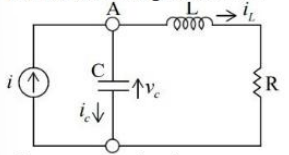
The state equation is:-Arrange the following in the sequence of steps for writing STATE EQUATION:-
A. Choose a normal tree for a network
B. Take either voltages or charges across the capacitor, which are tree branches and eithercurrents or fluxes through inductors, which are co-tree chords
C. Write independent KVL, KCL and branch voltage current relations (VCR).
D. Rearrange the vector matrix differential equation for state variable representation.
E. Eliminate all non-state variables of the network
Choose the correct answer from the options given below:- The state and output equations for a control system are:
$$\dot{x} = \begin{bmatrix} -4 & -1.5 \\ 4 & 0 \end{bmatrix}x + \begin{bmatrix} 2 \\ 0 \end{bmatrix}u$$
$$y = \begin{bmatrix} 1.5 & 0.625 \end{bmatrix}x$$
Which of the following expressions correctly represents the transfer function $\frac{Y(s)}{U(s)}$ of the system with zero initial conditions? - The state-space model of a system is given as
$$ \begin{bmatrix} \dot{x}_1 \\ \dot{x}_2 \end{bmatrix} = \begin{bmatrix} 1 & 0 \\ 1 & 1 \end{bmatrix} \begin{bmatrix} x_1 \\ x_2 \end{bmatrix} + \begin{bmatrix} 1 \\ 1 \end{bmatrix} u(t) $$
where u(t) is a unit step input occurring at t = 0 and $x(0) = \begin{bmatrix} 1 \\ 0 \end{bmatrix}$.
The time response of the system is


