
A discrete system is represented by the difference equation \(\left[ {\begin{array}{*{20}{c}} {{X_1}\left( {k + 1} \right)}\\ {{X_2}\left( {k + 1} \right)} \end{array}} \right] = \left[ {\begin{array}{*{20}{c}} a&{a - 1}\\ {a + 1}&a \end{array}} \right]\left[ {\begin{array}{*{20}{c}} {{X_1}\left( k \right)}\\ {{X_2}\left( k \right)} \end{array}} \right]\)
1 ± j0
Understanding Discrete System Pole Locations
This problem asks us to find the pole locations of a discrete system represented by a state-space difference equation. The system is defined as:
$$ \begin{bmatrix} X_1(k + 1) \\ X_2(k + 1) \end{bmatrix} = \begin{bmatrix} a & a - 1 \\ a + 1 & a \end{bmatrix} \begin{bmatrix} X_1(k) \\ X_2(k) \end{bmatrix} $$We are given initial conditions $X_1(0) = 1$ and $X_2(0) = 0$, and we need to find the pole locations specifically when the parameter a = 1.
Identifying the State-Transition Matrix
The general form of a discrete-time linear time-invariant (LTI) system in state-space is given by $X(k+1) = A X(k)$, where $X(k)$ is the state vector and $A$ is the state-transition matrix. From the provided difference equation, we can identify the state-transition matrix $A$ as:
$$ A = \begin{bmatrix} a & a - 1 \\ a + 1 & a \end{bmatrix} $$Calculating Pole Locations for a = 1
To find the pole locations, we need to evaluate the state-transition matrix $A$ at the given parameter value, a = 1.
Substituting a = 1 into the matrix $A$:
The pole locations of a system are the eigenvalues of its state-transition matrix. To find the eigenvalues ($\lambda$), we solve the characteristic equation:
det(A - λI) = 0
where $I$ is the identity matrix.
First, we form the matrix $(A - \lambda I)$:
$$ A - \lambda I = \begin{bmatrix} 1 & 0 \\ 2 & 1 \end{bmatrix} - \lambda \begin{bmatrix} 1 & 0 \\ 0 & 1 \end{bmatrix} = \begin{bmatrix} 1 - \lambda & 0 \\ 2 & 1 - \lambda \end{bmatrix} $$Now, we calculate the determinant:
$$ \det(A - \lambda I) = (1 - \lambda)(1 - \lambda) - (0)(2) $$ $$ \det(A - \lambda I) = (1 - \lambda)^2 $$Setting the determinant to zero to find the eigenvalues:
$$ (1 - \lambda)^2 = 0 $$Solving for $\lambda$ gives:
$$ 1 - \lambda = 0 \implies \lambda = 1 $$This equation indicates a repeated eigenvalue at $\lambda = 1$. Therefore, the pole locations are $1$ and $1$. These can be expressed in the form $p \pm jq$ as $1 \pm j0$. The initial conditions provided ($X_1(0)=1$, $X_2(0)=0$) are not needed to determine the pole locations, which are intrinsic properties of the system matrix $A$. The initial conditions affect the specific response trajectory of the system, but not the locations of its poles.
Matching with Options
Comparing our calculated pole locations ($1, 1$ or $1 \pm j0$) with the given options:
- Option 1: $1 \pm j0$ (matches our result)
- Option 2: $-1 \pm j0$ (corresponds to eigenvalues -1, -1)
- Option 3: $\pm1 + j0$ (corresponds to eigenvalues 1, -1)
- Option 4: $0 \pm j1$ (corresponds to eigenvalues $j$, $-j$)
The calculated pole locations are $1 \pm j0$, which corresponds to Option 1.
Important Questions from State Space Representation
For the network given below:-
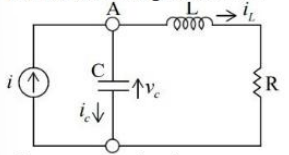
The state equation is:-Arrange the following in the sequence of steps for writing STATE EQUATION:-
A. Choose a normal tree for a network
B. Take either voltages or charges across the capacitor, which are tree branches and eithercurrents or fluxes through inductors, which are co-tree chords
C. Write independent KVL, KCL and branch voltage current relations (VCR).
D. Rearrange the vector matrix differential equation for state variable representation.
E. Eliminate all non-state variables of the network
Choose the correct answer from the options given below:- Consider the state-space representation of a system
$ \dot{x} = Ax + Bu $
where $x$ is the state vector, $u$ is the input, $A$ is the system matrix and $B$ is the input matrix. Choose the matrix $A$ from the following options such that the system has a pole at the origin. - The state and output equations for a control system are:
$$\dot{x} = \begin{bmatrix} -4 & -1.5 \\ 4 & 0 \end{bmatrix}x + \begin{bmatrix} 2 \\ 0 \end{bmatrix}u$$
$$y = \begin{bmatrix} 1.5 & 0.625 \end{bmatrix}x$$
Which of the following expressions correctly represents the transfer function $\frac{Y(s)}{U(s)}$ of the system with zero initial conditions? - The state-space model of a system is given as
$$ \begin{bmatrix} \dot{x}_1 \\ \dot{x}_2 \end{bmatrix} = \begin{bmatrix} 1 & 0 \\ 1 & 1 \end{bmatrix} \begin{bmatrix} x_1 \\ x_2 \end{bmatrix} + \begin{bmatrix} 1 \\ 1 \end{bmatrix} u(t) $$
where u(t) is a unit step input occurring at t = 0 and $x(0) = \begin{bmatrix} 1 \\ 0 \end{bmatrix}$.
The time response of the system is


