
Consider the following statements regarding network theorems : 1. With independent sources, superposition theorem can be used only when the control functions are external to the network containing the sources, so that the controls are unchanged as the sources act one at a time. 2. A linear, active, resistive network, which contains one or more voltage or current sources, can be replaced by a single voltage source and a series resistance or by a single current source and a parallel resistance. The voltage is called the Thévenin equivalent voltage and the current is Norton current. 3. The two resistances are the same in both Thévenin's and Norton's theorems which are obtained by deactivating all the sources. Which of the above statements is/are correct?
This question requires evaluating the correctness of statements related to fundamental network theorems: Superposition, Thévenin's, and Norton's theorems.
Analyzing Network Theorem Statements
Statement 1: Superposition Theorem Applicability
- The Superposition Theorem states that in a linear network containing multiple independent sources, the response (voltage or current) in any branch is the algebraic sum of responses caused by each independent source acting alone.
- To apply this theorem, independent sources are deactivated one by one (voltage sources replaced by short circuits, current sources by open circuits).
- Dependent sources are not deactivated; they remain active and are controlled by their respective variables in the circuit.
- The statement mentions "control functions are external" and "controls are unchanged". This is inaccurate. Control variables for dependent sources can be internal to the network, and they change as independent sources are activated individually. The linearity of the network is the primary condition.
- Therefore, Statement 1 is incorrect.
Statement 2: Thévenin and Norton Equivalents
- Thévenin's Theorem allows any linear, two-terminal network to be replaced by an equivalent circuit consisting of a single voltage source ($V_{Th}$) in series with an equivalent resistance ($R_{Th}$).
- Norton's Theorem allows the same network to be replaced by an equivalent circuit consisting of a single current source ($I_N$) in parallel with an equivalent resistance ($R_N$).
- $V_{Th}$ is the open-circuit voltage across the terminals, and $I_N$ is the short-circuit current across the terminals.
- Statement 2 accurately describes these equivalents for a linear, active, resistive network.
- Therefore, Statement 2 is correct.
Statement 3: Equivalent Resistances in Thévenin's and Norton's Theorems
- The equivalent resistance ($R_{Th}$ or $R_N$) in both Thévenin's and Norton's theorems is calculated by deactivating all independent sources within the network.
- Voltage sources are replaced by short circuits ($0$ V).
- Current sources are replaced by open circuits ( $0$ A).
- The resistance is then measured across the terminals of the network.
- This calculated resistance is the same for both $R_{Th}$ and $R_N$.
- Therefore, Statement 3 is correct.
Conclusion
Based on the analysis, statements 2 and 3 are correct, while statement 1 is incorrect.
Important Questions from Network Theorems
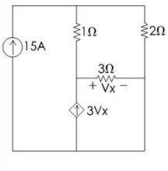
The power supplied by the dependent source in the figure is,
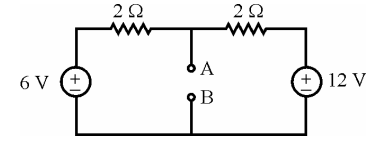
The Thevenin's equivalent across AB is
Which equivalent circuits are dual ?
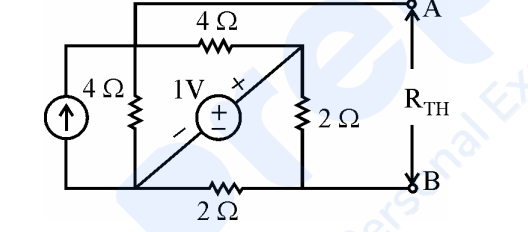
For the n/w, find RTH
The principle of superposition is the property of


