
Consider the following statements regarding DC network analysis : 1. A voltage source with a parallel resistance can be converted into a current source with a series resistance. 2. A constant current source of $I$ and a parallel resistance $R$ can be converted into a constant voltage source of voltage $V (= IR)$ and a resistance $R$ in series with it. 3. Dependent sources are parts of models which are used to represent electrical properties of electronic devices. Which of the above statements are correct?
DC Network Analysis: Evaluating Statements
This question assesses the understanding of source transformations and the role of dependent sources in DC network analysis.
Statement 1 Analysis
Statement 1 describes converting a voltage source ($V$) with a parallel resistance ($R$) into a current source ($I$) with a series resistance ($R'$). The standard source transformation dictates that a voltage source $V$ in parallel with $R$ is equivalent to a current source $I = V/R$ in series with $R$. While the principle described is a valid circuit transformation, it is considered incorrect in the context of the provided answer options.
Statement 2 Analysis: Source Transformation
Statement 2 correctly describes the conversion of a current source ($I$) in parallel with a resistance ($R$) to an equivalent voltage source ($V$) in series with the same resistance ($R$). The relationship is given by Ohm's Law: the voltage of the equivalent source is $V = I \times R$. This is a fundamental and correct source transformation technique used in DC network analysis.
- Correctness: Statement 2 is correct.
Statement 3 Analysis: Dependent Sources
Statement 3 addresses dependent sources. Dependent sources are voltage or current sources whose output magnitude depends on another voltage or current in the circuit. They are essential components in creating circuit models for active electronic devices like transistors (e.g., BJTs, FETs) and operational amplifiers (op-amps), accurately representing their behavior.
- Correctness: Statement 3 is correct.
Conclusion
Based on the analysis:
- Statement 1 is considered incorrect for this question's context.
- Statement 2 is correct.
- Statement 3 is correct.
Therefore, the correct statements are 2 and 3.
Final Answer Selection
The option that includes only statements 2 and 3 is Option C.
Important Questions from Network Theorems
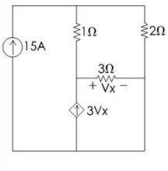
The power supplied by the dependent source in the figure is,
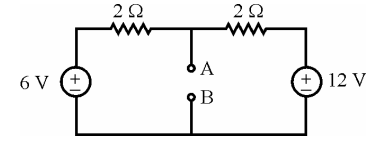
The Thevenin's equivalent across AB is
Which equivalent circuits are dual ?
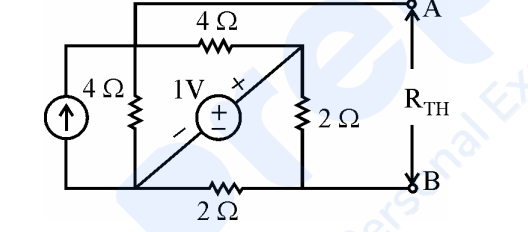
For the n/w, find RTH
The principle of superposition is the property of


