
Consider the following DFA 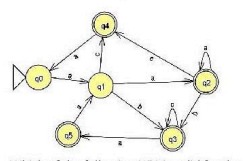
Which of the following NFA is valid for the given DFA?
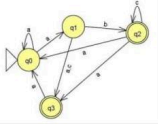
To determine which Non-deterministic Finite Automaton (NFA) corresponds to the given Deterministic Finite Automaton (DFA), we need to understand the basic conversion principles. An NFA is valid for a DFA if it can represent the same language, meaning that both recognize the same set of strings.
Key Differences Between DFA and NFA:
- In a DFA, each state has exactly one transition for each symbol in the alphabet.
- In an NFA, each state can have zero, one, or multiple transitions for a symbol.
The provided DFA recognizes a certain set of strings based on its state transitions. We will evaluate the provided NFA options to identify which represents the same language.
Correct NFA Analysis:
This NFA is valid as it matches the DFA transitions, allowing non-deterministic paths for input symbols. It will process the same strings as the DFA, although potentially in a more flexible manner on account of multiple possible states for a given input.
Conclusion:
The correct NFA for the given DFA is the one that can represent all the same strings accepted by the DFA. Here, the last option matches these criteria, effectively simulating the DFA's behavior with allowances for nondeterminism.
Important Questions from Finite Automata
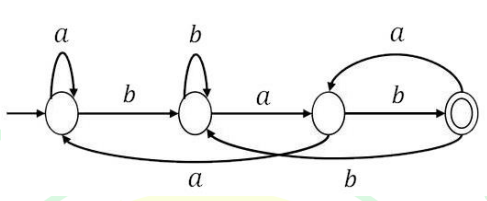
Consider the following deterministic finite automaton (DFA) defined over the alphabet, Σ = {𝑎, 𝑏}. Identify which of the following language(s) is/are accepted by the given DFA.
Consider a finite state machine (FSM) with one input 𝑋 and one output 𝑓, represented by the given state transition table. The minimum number of states required to realize this FSM is ________. (Answer in integer)
Present state Next state Output f X = 0 X = 1 X = 0 X = 1 A F B 0 0 B D C 0 0 C F E 0 0 D G A 1 0 E D C 0 0 F F B 1 1 G H 0 0 1 H G A 1 0 - Let $\Sigma = \{1,2,3,4\}$. For $x \in \Sigma^*$, let $prod(x)$ be the product of symbols in $x$ modulo 7. We take $prod(\epsilon) = 1$, where $\epsilon$ is the null string.
For example, $prod(124) = (1 \times 2 \times 4)$ mod 7 = 1.
Define $L = \{x \in \Sigma^* \mid prod(x) = 2\}$.
The number of states in a minimum state DFA for L is ____________ (Answer in integer) Consider the following two finite automata $D_1$ and $D_2$.
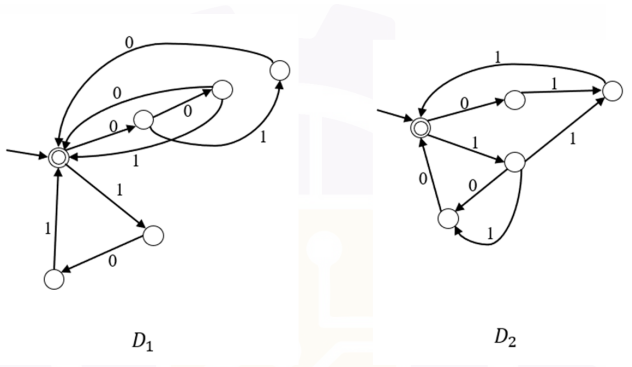
Which of the following statements is/are true?- Let $M$ be a nondeterministic finite automaton (NFA) with 6 states over a finite alphabet.
Which of the following options CANNOT be the number of states in the minimal deterministic finite automaton (DFA) that is equivalent to $M$ ?


