
Consider the following DFA that generates set of strings over $\Sigma=\{a, b, c\}$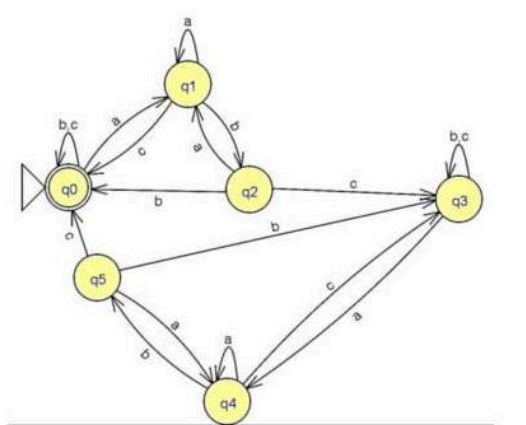
Now identify that which of the followings is the best description of the language for the above DFA
$L = \{\text{Set of strings, all having even count (including 0) of substring 'abc'}\}$
The given question involves analyzing a DFA and determining the language it accepts over the alphabet \Sigma = \{a, b, c\}. To solve this, we'll examine the transitions in the DFA provided by the image.
In the DFA provided, the language can be identified by examining its states and transitions:
- The DFA starts at state
q0, which is also the accepting state. - State
q0transitions to itself upon encountering 'b' or 'c'. - Entering state
q1occurs by reading 'a', transitioning eventually to the further states which form the pattern 'abc'. - Upon reading 'abc', we return to an accepting state if continued transitions repeat this process.
By following these steps, the DFA essentially allows strings with blocks of 'abc' where:
- The substring 'abc' can occur even number of times (0, 2, 4, etc.).
- Any combination of 'a', 'b', and 'c' may appear before or after these even repetitions of 'abc', but they do not affect the acceptance as long as 'abc' appears an even number of times.
Considering this, the correct language from the options provided is:
L = \{\text{Set of strings, all having even count (including 0) of substring 'abc'}\}
This clearly matches the behavior and acceptance logic of the presented DFA where the transitions enable it to remove back to the initial state if 'abc' is completed in cycles.
Important Questions from Finite Automata
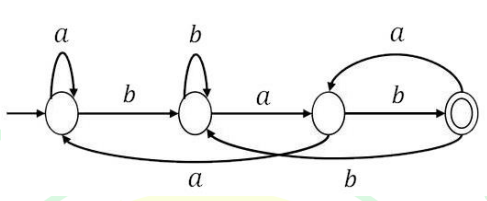
Consider the following deterministic finite automaton (DFA) defined over the alphabet, Σ = {𝑎, 𝑏}. Identify which of the following language(s) is/are accepted by the given DFA.
Consider a finite state machine (FSM) with one input 𝑋 and one output 𝑓, represented by the given state transition table. The minimum number of states required to realize this FSM is ________. (Answer in integer)
Present state Next state Output f X = 0 X = 1 X = 0 X = 1 A F B 0 0 B D C 0 0 C F E 0 0 D G A 1 0 E D C 0 0 F F B 1 1 G H 0 0 1 H G A 1 0 - Let $\Sigma = \{1,2,3,4\}$. For $x \in \Sigma^*$, let $prod(x)$ be the product of symbols in $x$ modulo 7. We take $prod(\epsilon) = 1$, where $\epsilon$ is the null string.
For example, $prod(124) = (1 \times 2 \times 4)$ mod 7 = 1.
Define $L = \{x \in \Sigma^* \mid prod(x) = 2\}$.
The number of states in a minimum state DFA for L is ____________ (Answer in integer) Consider the following two finite automata $D_1$ and $D_2$.
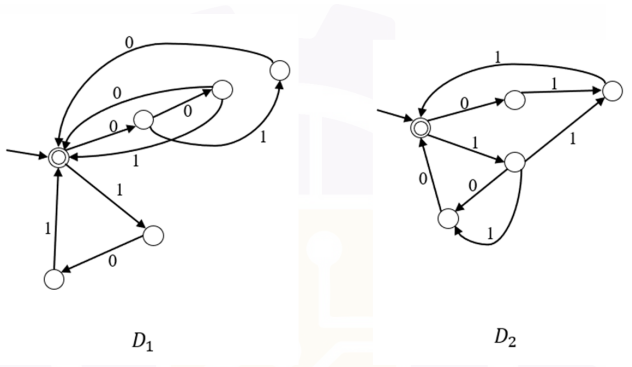
Which of the following statements is/are true?- Let $M$ be a nondeterministic finite automaton (NFA) with 6 states over a finite alphabet.
Which of the following options CANNOT be the number of states in the minimal deterministic finite automaton (DFA) that is equivalent to $M$ ?


