
Choose the correct relation between drift velocity (vd) and current density (J):
vd=neJ
Understanding Drift Velocity and Current Density
When a voltage is applied across a conductor, free electrons (or other charge carriers) inside the conductor don't move randomly anymore. They acquire a small average velocity in a direction opposite to the electric field (if the charge carriers are negative, like electrons). This small average velocity is called the drift velocity (\(v_d\)).
Current density (\(J\)) is a vector quantity that describes the electric current flowing through a unit cross-sectional area of the conductor. It tells us how concentrated the current is at a particular point.
Relating Current, Drift Velocity, and Charge Carriers
Let's consider a conductor with a uniform cross-sectional area \(A\).
- Let \(n\) be the number of charge carriers per unit volume (number density).
- Let \(e\) be the magnitude of the charge of each carrier (e.g., for electrons, \(e = 1.6 \times 10^{-19}\) C).
- Let \(v_d\) be the average drift velocity of the charge carriers.
In a time interval \(\Delta t\), the charge carriers that pass through a cross-section of the conductor are those initially contained in a cylinder of length \(v_d \Delta t\) and area \(A\). The volume of this cylinder is \(A \times (v_d \Delta t)\).
The number of charge carriers in this volume is \(n \times (A v_d \Delta t)\).
The total charge (\(\Delta Q\)) passing through the cross-section in time \(\Delta t\) is the number of carriers multiplied by the charge of each carrier:
\(\Delta Q = (n A v_d \Delta t) \times e\)
The electric current (\(I\)) is the rate of flow of charge:
\(I = \frac{\Delta Q}{\Delta t} = \frac{n A v_d e \Delta t}{\Delta t} = n A v_d e\)
So, the relation between current and drift velocity is \(I = n A v_d e\).
Deriving the Relation between Drift Velocity and Current Density
Current density \(J\) is defined as the current per unit area:
\(J = \frac{I}{A}\)
Now, substitute the expression for \(I\) (\(I = n A v_d e\)) into the definition of \(J\):
\(J = \frac{n A v_d e}{A}\)
The area \(A\) cancels out:
\(J = n v_d e\)
or \(J = n e v_d\)
We need to find the relation for drift velocity \(v_d\). We can rearrange this equation to solve for \(v_d\):
\(v_d = \frac{J}{ne}\)
This equation shows the relationship between drift velocity (\(v_d\)) and current density (\(J\)), number density of charge carriers (\(n\)), and elementary charge (\(e\)).
Analyzing the Options
Let's compare our derived relation with the given options:
- Option 1: \(v_d = Jne\). This is incorrect.
- Option 2: \(v_d = \frac{J}{ne}\). This matches our derived relation.
- Option 3: \(v_d = \frac{J}{neA}\). This includes the area \(A\), which is not present in the current density definition, so it's incorrect. \(J\) already accounts for the area.
- Option 4: \(v_d = \frac{J}{ne^2A}\). This includes \(A\) and \(e^2\), which is also incorrect.
Therefore, the correct relation is \(v_d = \frac{J}{ne}\).
Revision Table: Key Formulas
| Quantity | Symbol | Formula | Units (SI) |
|---|---|---|---|
| Drift Velocity | \(v_d\) | \(v_d = \frac{J}{ne}\) | m/s |
| Current | \(I\) | \(I = n A v_d e\) | Ampere (A) |
| Current Density | \(J\) | \(J = \frac{I}{A} = n e v_d\) | A/m\(^2\) |
| Number Density of Charge Carriers | \(n\) | m\(^{-3}\) | |
| Elementary Charge | \(e\) | \(1.602 \times 10^{-19}\) | Coulomb (C) |
| Cross-sectional Area | \(A\) | m\(^2\) |
Additional Information: Drift Velocity and Mobility
The drift velocity is often related to the electric field \(E\) applied across the conductor. The relation is \(v_d = \mu E\), where \(\mu\) is the mobility of the charge carriers. Mobility is a measure of how easily charge carriers move through a material under the influence of an electric field.
Substituting this into the current density equation \(J = ne v_d\), we get:
\(J = ne (\mu E) = (ne\mu) E\)
We know that Ohm's Law can be written in terms of current density and electric field as \(J = \sigma E\), where \(\sigma\) is the conductivity of the material. Comparing this with \(J = (ne\mu) E\), we find that the conductivity of a material is related to the number density and mobility of charge carriers:
\(\sigma = ne\mu\)
These relationships highlight how microscopic properties (like \(n\), \(e\), \(v_d\), \(\mu\)) are connected to macroscopic properties (like \(I\), \(J\), \(E\), \(\sigma\)).
Important Questions from Current Electricity
Figure shows drift speed Vd of conduction electrons in a copper wire versus position (X) for the three sections. Then,
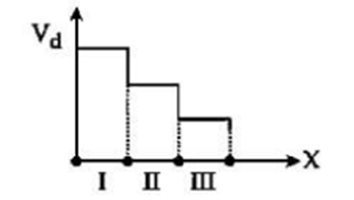
A. Radius of III > Radius of II > Radius of I
B. Electric Field in III > Electric Field in II > Electric Field in I
C. Radius of wire is same in all sections
D. Conductivity is same in all sections
Choose the correct answer from the options given below:
Which of the following circuits cannot be used to measure the resistance of resistor R?
The temperature at which the resistance of a conductor becomes 30% more than that of its resistance at 47°C will be:
(Given the value of the temperature coefficient of resistance of the conductor is 2 × 10⁻⁴ K-1.)
Cell having an emf E and internal resistance r is connected across a variable external resistance R. As the resistance R is increased, the plot of potential difference V across R is given by:
In the potentiometer circuit, the balance point is at X. The balance point will be shifted right towards B when:
A. Resistance R is increased keeping all other parameters constant
B. Resistance S is increased keeping all other parameters constant
C. Cell P is replaced by another cell whose emf is lower than Q
D. The polarity of Q is reversed
Choose the correct answer from the options given below:


