
Calculate the current I through each of the transistor Q2 and Q3 in the circuit given below :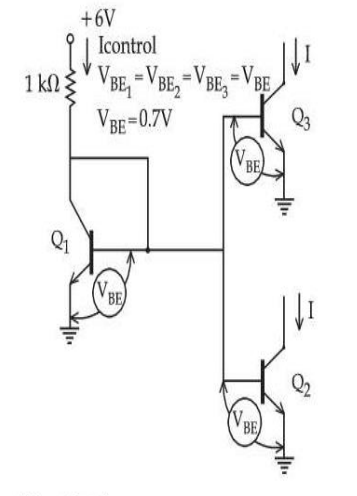
5.3 mA
A current mirror copies whatever current the reference branch carries, so the whole problem is one application of Ohm's law to that branch.
Step 1 — the reference current. The 1 kΩ resistor runs from the +6 V supply to the diode-connected transistor Q1, whose base-emitter junction holds 0.7 V with its emitter at ground. The voltage across the resistor is therefore the supply less that one junction drop:
\(V_{R}=6-0.7=5.3\ \text{V}\)
\(I_{control}=\dfrac{V_{R}}{R}=\dfrac{5.3}{1\ \text{k}\Omega}=5.3\ \text{mA}\)
Step 2 — the mirroring. Q1, Q2 and Q3 share the same base node and all three emitters are grounded, so all three have identical \(V_{BE}\). Since collector current depends exponentially on that one voltage,
\(I_{C}=I_{S}e^{V_{BE}/V_{T}}\)
matched transistors at the same \(V_{BE}\) must carry the same current. Hence
\(I=I_{control}=5.3\ \text{mA}\)
— option 2, through each of Q2 and Q3.
Why option 1 is the trap. Taking 6 V across the resistor and forgetting the 0.7 V junction drop gives exactly 6 mA. The diode-connected transistor is in series with the resistor, so its drop must be subtracted.
Why the mirror works so well. Its accuracy rests on matching, not on absolute values. Two transistors made side by side on the same die have nearly identical \(I_{S}\) and sit at the same temperature, so their currents track even as temperature and supply vary — something no resistor-based bias scheme achieves. Making the output transistor's emitter area a multiple of the reference's scales the copied current by that ratio, which is how a single reference biases a whole chip.
The base-current error, for completeness. The reference branch must supply base current to all three transistors, so strictly
\(I_{out}=\dfrac{I_{ref}}{1+\dfrac{3}{\beta}}\)
For \(\beta=100\) that is a 3 % shortfall. The question's \(V_{BE}=0.7\) V idealisation intends the base currents to be neglected, and a Wilson or buffered mirror removes the error in real designs.
Hence, the current through each transistor is 5.3 mA.



