
Reason (R) : Two circuits are said to be dual when the mesh equations that describe the behaviour of one circuit are found to be identical in the form of nodal equations that describe the other.
This question assesses the understanding of the duality property in electrical circuit analysis.
Assertion (A) Analysis: Duality Property
Assertion (A) states that "Duality is a property of circuit equations." This statement is true. Duality is a fundamental concept in network theory, linking different but related representations of electrical circuits. It allows analysis techniques developed for one type of circuit representation (e.g., mesh analysis) to be applied to another (e.g., nodal analysis) by transforming the circuit or the equations.
Reason (R) Analysis: Defining Dual Circuits
Reason (R) defines dual circuits: "Two circuits are said to be dual when the mesh equations that describe the behaviour of one circuit are found to be identical in the form of nodal equations that describe the other." This statement is also true. It accurately describes the relationship between the equations of dual circuits, highlighting the interchangeability between loop analysis (using mesh equations) and node analysis (using nodal equations).
Evaluating Reason (R) as Explanation for Assertion (A)
While both Assertion (A) and Reason (R) are factually correct statements about circuit duality:
- Assertion (A) broadly states that duality is a property.
- Reason (R) provides a specific example of this property manifesting through the equivalence of mesh and nodal equation forms.
However, Reason (R) does not fully explain *why* duality is considered a property of circuit equations. It describes *how* duality is observed using specific analytical methods (mesh vs. nodal), rather than explaining the underlying principle or origin of the property itself. Duality encompasses more than just this specific equation transformation; it also involves transformations of circuit elements and configurations (e.g., voltage/current sources, series/parallel connections). Therefore, Reason (R) is true but not the correct or complete explanation for Assertion (A).
Conclusion
Both the assertion and the reason are true statements. However, the reason explains a specific consequence or manifestation of duality rather than the fundamental reason why duality is a property of circuit equations.
Therefore, the correct option is that both (A) and (R) are true, but (R) is not the correct explanation of (A).
Important Questions from Network Theorems
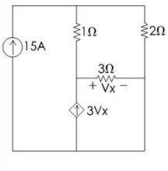
The power supplied by the dependent source in the figure is,
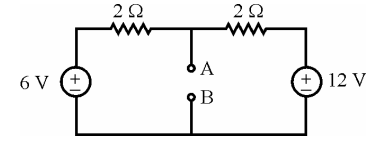
The Thevenin's equivalent across AB is
Which equivalent circuits are dual ?
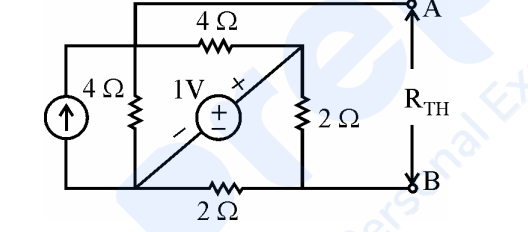
For the n/w, find RTH
The principle of superposition is the property of


