
P. Oil quenching
Q. Water quenching
R. Water quenching with agitation
S. Brine quenching
Quenching Severity Order Explained
Quenching is a heat treatment process used to harden metals, primarily steels, by rapidly cooling them from a high temperature. The severity of quenching refers to the rate at which the material cools. A higher cooling rate generally leads to a greater degree of hardening but can also increase brittleness.
The cooling rate depends on the properties of the quenching medium (like thermal conductivity, specific heat, and viscosity) and the cooling conditions (like agitation).
Severity Comparison of Quenching Methods
Let's analyze the severity based on typical cooling rates:
- P. Oil quenching: Oil has lower thermal conductivity and absorbs heat more slowly than water. This results in a relatively slow cooling rate.
- Q. Water quenching: Water has higher thermal conductivity and diffusivity than oil, allowing for a faster cooling rate compared to oil.
- R. Water quenching with agitation: Agitating the water enhances the removal of the vapor phase (which acts as an insulator) and improves heat transfer. This leads to a faster cooling rate than still water quenching.
- S. Brine quenching: Brine (saltwater solution) has significantly higher thermal conductivity and diffusivity than pure water. It promotes very rapid heat extraction, resulting in the highest cooling rate among these options.
Therefore, arranging these methods in terms of increasing severity (i.e., increasing cooling rate) gives:
Oil quenching (P) < Water quenching (Q) < Water quenching with agitation (R) < Brine quenching (S)
The correct order is P<Q<R<S.
Important Questions from Heat Treatment Quenching Critical Cooling Rate
- Which of the following statements is/are CORRECT when Ni is added as an alloying element to a low alloy steel?
- In a Jominy end-quench test of the eutectoid plain-carbon steel, which of the following represents the sequence of microstructures observed from the quenched end of the specimen?
- Which one of the following is the correct decreasing sequence of Quenching Power for quenchants used in heat treatment of steels?
- Which one of the following techniques does NOT require quenching to obtain final case hardness?
The microstructures of a quenched steel tempered at three temperatures $T_1 < T_2 < T_3$ for a fixed time are schematically illustrated. The solid circles represent cementite particles in ferrite matrix; $\bar{r}_1, \bar{r}_2$ and $\bar{r}_3$ are average radii of cementite particles, and $V_1, V_2$ and $V_3$ are volume fractions of cementite at temperatures $T_1, T_2$ and $T_3$, respectively.
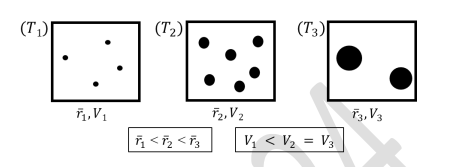
If the cementite in steel is more noble than ferrite, then which one of the three microstructures will have the highest corrosion rate when exposed to an aqueous solution of $3.5 \text{ wt.\% NaCl}$?


