
(A). Acetamide
(B). Acetyl chloride
(C). Ethyl acetate
(D). Acetic anhydride
Choose the correct answer from the options given below:
Understanding Compound Hydrolysis Rates
The hydrolysis of acyl compounds involves their reaction with water, typically breaking the bond between the carbonyl carbon and the attached group (like -Cl, -OOCR, -OR, or -NR2). The rate of this reaction depends significantly on two main factors:
- The electrophilicity of the carbonyl carbon atom.
- The stability of the leaving group that departs during the reaction.
A more electronegative atom or group attached to the carbonyl carbon increases its electrophilicity. Similarly, a more stable anion or molecule as a leaving group facilitates a faster reaction. We need to arrange Acetamide (A), Acetyl chloride (B), Ethyl acetate (C), and Acetic anhydride (D) in decreasing order of their hydrolysis rates.
Analyzing Reactivity of Acyl Compounds
Let's examine each compound:
- (B) Acetyl chloride: Contains a chlorine atom attached to the carbonyl group. Chlorine is highly electronegative, making the carbonyl carbon very electron-deficient (highly electrophilic). Chloride ion ($Cl^-$) is a stable anion and an excellent leaving group. This makes acetyl chloride highly reactive towards hydrolysis.
- (D) Acetic anhydride: Has an acetoxy group ($CH_3COO^-$) as the potential leaving group. Oxygen atoms pull electron density, making the carbonyl carbon electrophilic, though less so than in acetyl chloride. The acetate ion is stabilized by resonance, making it a good leaving group, although less effective than $Cl^-$. Thus, acetic anhydride hydrolyzes faster than esters and amides.
- (C) Ethyl acetate: This is an ester. The ethoxy group ($CH_3CH_2O^-$) is a poorer leaving group compared to chloride or acetate because the ethoxide ion is less stable. The carbonyl carbon is less electrophilic than in acetyl chloride or acetic anhydride. Hydrolysis is slower.
- (A) Acetamide: This is an amide. The amino group ($NH_2^-$) is a very poor leaving group as the amide anion is highly unstable. The nitrogen atom can donate electron density to the carbonyl group via resonance, reducing the electrophilicity of the carbonyl carbon. Therefore, amides are the least reactive towards hydrolysis among these compounds.
Determining the Decreasing Order of Hydrolysis Rates
Based on the analysis of leaving group ability and carbonyl electrophilicity, the reactivity order is:
Acetyl chloride (B) > Acetic anhydride (D) > Ethyl acetate (C) > Acetamide (A)
This is because the leaving group ability follows the order: $Cl^- > CH_3COO^- > CH_3CH_2O^- >> NH_2^-$.
Therefore, the correct arrangement in decreasing order of their rates of hydrolysis with water is (B), (D), (C), (A).
Important Questions from Chemistry (CUET PG) Mixed
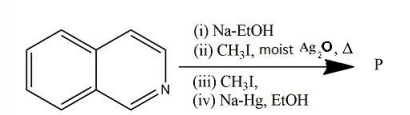
The final product (P) is
Consider the following statements with respect to citral
(A). Geranial and Neral are geometrical isomers of citral.
(B). It forms geranic acid on heating with potassium hydrogen sulphate.
(C). It gives 6-methylhept-5-en-2-one on treating with potassium carbonate.
(D). On oxidation with silver oxide it yields Laevulic acid.
Choose the correct answer from the options given below:Which correct sequence of reactions are applied to achieve the following transformation?

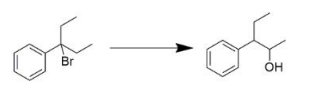
Above conversion is carried out using

The final product (D) in the above conversion is


