The problem asks for the height of the point of contact between an inclined plane and a horizontal cylinder. We are given that the cylinder has radius $R$ and the inclined plane makes an angle of $30^\circ$ with the ground.
Geometric Setup
Assume the horizontal cylinder rests on the ground. Its center, let's call it $C$, is at a height $R$ from the ground. The inclined plane is tangent to the cylinder at a point $P$. The radius $CP$ connecting the center to the point of contact $P$ is perpendicular to the inclined plane. The angle between the inclined plane and the ground (horizontal) is $30^\circ$.
Deriving the Height
We can visualize a right-angled triangle involving the radius $CP$.
- Draw a horizontal line passing through the center $C$.
- The angle between the inclined plane and this horizontal line is also $30^\circ$.
- Since the radius $CP$ is perpendicular to the inclined plane, the angle between $CP$ and the horizontal line through $C$ is $90^\circ - 30^\circ = 60^\circ$.
- Let $h$ be the height of the point of contact $P$ from the ground. The height of the center $C$ is $R$.
- Consider the vertical distance between $C$ and $P$. This distance is given by the component of the radius $CP$ along the vertical direction. In the right triangle formed by $C$, $P$, and the projection of $P$ onto the horizontal line through $C$, this vertical distance is $R \sin(60^\circ)$.
- Since the inclined plane slopes upwards and rests against the cylinder, the point of contact $P$ must be vertically above the horizontal line passing through $C$.
- Therefore, the total height $h$ of point $P$ is the height of the center $C$ plus this vertical distance: $h = R + R \sin(60^\circ)$
- Substitute the value of $\sin(60^\circ) = \frac{\sqrt{3}}{2}$: $h = R + R \left( \frac{\sqrt{3}}{2} \right)$ $h = R \left( 1 + \frac{\sqrt{3}}{2} \right)$
- Calculate the numerical value: $\frac{\sqrt{3}}{2} \approx 0.866$. $h \approx R (1 + 0.866)$ $h \approx 1.866 R$
The height of the point of contact is approximately $1.866 R$.
Important Questions from Geometry (Notes)
- In a triangle PQR, if $\angle P + \angle R = 150^\circ$ and $\angle P + 3\angle Q = 170^\circ$, then $\angle P$ is equal to :
- PQR is a triangle. The bisectors of the internal angle $\angle Q$ and external angle $\angle R$ intersect at M. If $\angle QMR = 40^\circ$, then $\angle P$ is :
- A $2\text{ m}$ long ladder is to reach a wall of height $1.75\text{ m}$. The largest possible horizontal distance of the ladder from the wall could be
A, B, C, D are points on a circle with AB=5 cm, BC=12 cm, AC=13 cm and AD=7cm. Then, the closest approximation of CD is
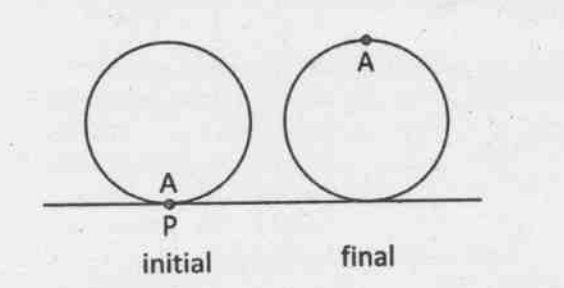
Point $A$ on a wheel of radius $r$ touches the horizontal plane at point $P$. It rolls without slipping, till point $A$ is at the highest position in the first turn. What is the final distance $AP$?