
Understanding Negative Cooperativity
The question describes a scenario where an enzyme's inhibitor binding exhibits negative cooperativity. This occurs when the binding of an inhibitor molecule to one site decreases the enzyme's affinity (increases the dissociation constant) for inhibitor binding at another site.
Hill Coefficient Significance
The Hill coefficient (often denoted as nH or simply n) quantifies the degree of cooperativity in ligand binding:
- n = 1: Indicates non-cooperative binding, where binding events are independent.
- n > 1: Indicates positive cooperativity, where binding of one ligand increases affinity for subsequent ligands.
- n < 1: Indicates negative cooperativity, where binding of one ligand decreases affinity for subsequent ligands.
Determining the Hill Coefficient
In this specific case, the problem explicitly states that binding to the first inhibitor site leads to negative cooperativity. According to the definition of the Hill coefficient:
- For negative cooperativity, the Hill coefficient must be less than one.
Therefore, the Hill coefficient for this inhibitor is less than one.
Important Questions from Enzyme Kinetics Michaelis Menten K_m V_{max}
- An enzyme following Michaelis-Menten kinetics, catalyses a reaction with an initial velocity ($V_0$) of $2\ \mu\text{M s}^{-1}$ at the substrate concentration of $10\ \mu\text{M}$. If the turnover number ($k_{\text{cat}}$) of the enzyme for the given substrate is $500\ \text{s}^{-1}$ and the enzyme concentration in the reaction is $0.01\ \mu\text{M}$, then the value of the Michaelis-Menten constant ($K_m$) would be__________ $\times\ 10^{-6}\ \text{M}$ (in integer).
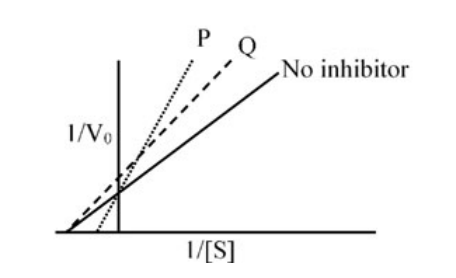
The graph below shows the activity of enzyme pepsin in the presence of inhibitors aliphatic alcohols (P) or N-acetyl-1-phenylalanine (Q). Which ONE of the following represents the nature of inhibition by P and Q, respectively?
The following plot represents the Lineweaver-Burk equation of an enzymatic reaction both in the presence and the absence of inhibitor. Here, V is the velocity of reaction and S is the substrate concentration.
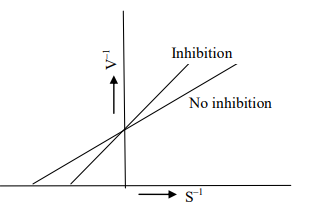
The nature of inhibition shown in the plot is
- For an enzyme catalyzed reaction, the plot that correctly represents the relationship between the rate and temperature is
- In an enzyme catalyzed reaction, the initial reaction velocity is only one fourth of its maximum velocity. If the substrate concentration is $3.0 \times 10^{-3}$ mM, the value of $K_m$ in micro molar ($\mu$M) will be ....


