
A trapezium has vertices marked as P, Q, R and S (in that order anticlockwise). The side PQ is parallel to side SR.
Further, it is given that, PQ = 11 cm, QR = 4 cm, RS = 6 cm and SP = 3 cm.
What is the shortest distance between PQ and SR (in cm)?
Trapezium Parallel Sides Distance Calculation
The question asks for the shortest distance between the parallel sides PQ and SR of a trapezium PQRS. This distance is the height ($h$) of the trapezium relative to these parallel bases.
Given values are:
- Trapezium vertices: P, Q, R, S (in anticlockwise order)
- Parallel sides: PQ || SR
- Side lengths: PQ = 11 cm, QR = 4 cm, RS = 6 cm, SP = 3 cm
Geometric Setup for Trapezium Height
Let PQ be the longer base and SR be the shorter base. To find the height $h$, we can draw perpendiculars from the endpoints of the shorter base (S and R) to the longer base (PQ).
Let X and Y be the points on PQ such that SX is perpendicular to PQ and RY is perpendicular to PQ.
This forms:
- A rectangle between the perpendiculars, implying $XY = SR = 6$ cm.
- Two right-angled triangles: $\triangle SPX$ and $\triangle RQY$.
- The height of the trapezium is $h = SX = RY$.
The length of the base PQ can be expressed as $PX + XY + YQ$. Substituting the known values: $11 \text{ cm} = PX + 6 \text{ cm} + YQ$. This simplifies to $PX + YQ = 11 - 6 = 5 \text{ cm}$.
Pythagorean Theorem Application
Using the Pythagorean theorem on the two right-angled triangles:
- In $\triangle SPX$: $SP^2 = PX^2 + SX^2$
$\implies 3^2 = PX^2 + h^2$
$\implies 9 = PX^2 + h^2$ (Equation 1) - In $\triangle RQY$: $QR^2 = RY^2 + YQ^2$
$\implies 4^2 = h^2 + YQ^2$
$\implies 16 = h^2 + YQ^2$ (Equation 2)
Solving for Trapezium Height
From Equation 1, $PX = \sqrt{9 - h^2}$. From Equation 2, $YQ = \sqrt{16 - h^2}$.
Substitute these expressions for PX and YQ into the equation $PX + YQ = 5$: $\sqrt{9 - h^2} + \sqrt{16 - h^2} = 5$.
This equation can be solved for $h$. An efficient method is to test the given options. Let's test $h = 2.4$ cm.
- Calculate PX: $PX = \sqrt{9 - (2.4)^2} = \sqrt{9 - 5.76} = \sqrt{3.24} = 1.8$ cm.
- Calculate YQ: $YQ = \sqrt{16 - (2.4)^2} = \sqrt{16 - 5.76} = \sqrt{10.24} = 3.2$ cm.
- Verify the sum: $PX + YQ = 1.8 \text{ cm} + 3.2 \text{ cm} = 5.0 \text{ cm}$.
The sum $PX + YQ = 5$ cm matches the condition derived from the base length PQ. Therefore, the height $h = 2.4$ cm is correct.
Final Answer Determination
The shortest distance between the parallel sides PQ and SR is the calculated height $h$.
The shortest distance is 2.4 cm.
Important Questions from Mensuration and Geometry
In the given figure, $P, Q$, and $R$ are three points on a circle of radius 10 cm with $O$ as its center, $\overline{PQ} = \overline{RQ}$, and $\angle PQR = 45^\circ$. The figure is representative.
The area of the shaded region $PQRO$ is ______________ cm$^2$.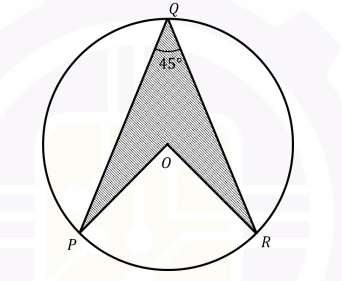
- A straight line $y = x - 1$ intersects a circle with center at $x = 1, y = 1$ and radius of magnitude 1 at two points. The length of the chord formed by this intersection is _______. (rounded off to three decimal places)
- The shell of a hollow spherical nanoparticle has a uniform thickness of 3 nanometers (nm). The outer radius of the nanoparticle is 5 nm. The ratio of the volume of the shell to the volume of the hollow core is ________
(Round off to one decimal place) - The volume of a sphere of diameter 1 unit is ______ than the volume of a cube of side 1 unit.
- A window is made up of a square portion and an equilateral triangle portion above it. The base of the triangular portion coincides with the upper side of the square. If the perimeter of the window is 6 m, the area of the window in $m^2$ is ______


