
A transparent square sheet shown above is folded along the dotted line. The folded sheet will look like _____________

1. Concept of Transparent Folding:
When a transparent square sheet is folded along a dotted line, the designs on both halves of the sheet overlap. Because the sheet is transparent, the pattern from the folded side appears superimposed on the pattern of the stationary side.
2. Visual Analysis:
- Left Side: Contains a rising curve with vertical hash marks.
- Right Side: Contains a falling curve with horizontal hash marks.
- Dotted Line: A vertical axis of symmetry in the center.
3. Step-by-Step Folding Process:
If we fold the right half onto the left half:
- The curve on the right will flip over the center line. In this specific image, the curves are roughly symmetrical, so they will align on top of each other.
- The horizontal marks from the right side will move to the left side, maintaining their orientation relative to the curve.
- The resulting image will show a single curved line on the left side of the square, now carrying both the original vertical marks and the newly overlapping horizontal marks.
Final Answer:
The folded sheet will look like a half-square (or a full square with one blank side) where the patterns from both sides are combined into one single design. Making option 2 the correct answer.
Important Questions from Paper Folding
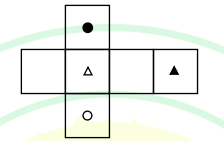
The paper as shown in the figure is folded to make a cube where each square corresponds to a particular face of the cube. Which one of the following options correctly represents the cube?
Note: The figures shown are representative.
Two identical sheets A and B, of dimensions $24$ cm $\times$ $16$ cm, can be folded into half using two distinct operations, FO1 or FO2.
In FO1, the axis of folding remains parallel to the initial long edge, and in FO2, the axis of folding remains parallel to the initial short edge.
If sheet A is folded twice using FO1, and sheet B is folded twice using FO2, the ratio of the perimeters of the final shapes of A and B is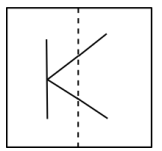
A transparent square sheet shown above is folded along the dotted line. The folded sheet will look like ________________.- Consider two rectangular sheets, Sheet M and Sheet N of dimensions 6 cm x 4 cm each.
Folding operation 1: The sheet is folded into half by joining the short edges of the current shape.
Folding operation 2: The sheet is folded into half by joining the long edges of the current shape.
Folding operation 1 is carried out on Sheet M three times.
Folding operation 2 is carried out on Sheet N three times.
The ratio of perimeters of the final folded shape of Sheet N to the final folded shape of Sheet M is ________. 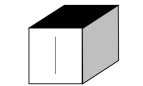
Consider a cube made by folding a single sheet of paper of appropriate shape.
The interior faces of the cube are all blank. However, the exterior faces that arenot visible in the above view may not be blank.
Which one of the following represents a possible unfolding of the cube?


