
Initial Area of the Square Sheet
The original square sheet has a side length of 1 unit. The initial area ($A_0$) is calculated as:
$ A_0 = \text{side} \times \text{side} = 1 \text{ unit} \times 1 \text{ unit} = 1 \text{ square unit} $
Area After First Fold (Along Main Diagonal)
Folding the square sheet along its main diagonal divides the square into two congruent right-angled triangles. This reduces the effective area by half.
$ A_1 = \frac{1}{2} \times A_0 = \frac{1}{2} \times 1 = \frac{1}{2} \text{ square unit} $
Area After Second Fold (Along Line of Symmetry)
The shape after the first fold is an isosceles right-angled triangle. Folding this shape along its line of symmetry (the altitude from the right angle to the hypotenuse) again halves the area.
$ A_2 = \frac{1}{2} \times A_1 = \frac{1}{2} \times \frac{1}{2} = \frac{1}{4} \text{ square unit} $
Area After Third Fold (Along Line of Symmetry)
The shape resulting from the second fold is a smaller isosceles right-angled triangle. Folding this shape again along its line of symmetry halves the area once more.
$ A_3 = \frac{1}{2} \times A_2 = \frac{1}{2} \times \frac{1}{4} = \frac{1}{8} \text{ square unit} $
Final Area of Each Face
The final folded shape has an area of $\frac{1}{8}$ square units. This represents the area of each face (top and bottom surface) of the final folded paper shape.
Important Questions from Paper Folding
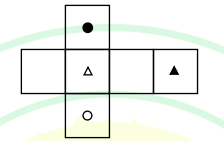
The paper as shown in the figure is folded to make a cube where each square corresponds to a particular face of the cube. Which one of the following options correctly represents the cube?
Note: The figures shown are representative.
A planar rectangular paper has two V-shaped pieces attached as shown below.
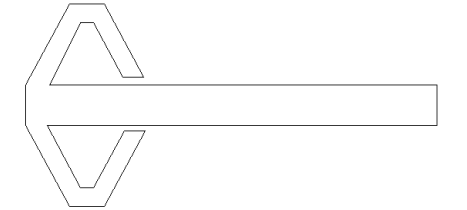
This piece of paper is folded to make the following closed three-dimensional object.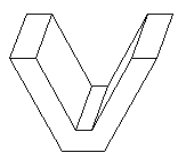
The number of folds required to form the above object isTwo identical sheets A and B, of dimensions $24$ cm $\times$ $16$ cm, can be folded into half using two distinct operations, FO1 or FO2.
In FO1, the axis of folding remains parallel to the initial long edge, and in FO2, the axis of folding remains parallel to the initial short edge.
If sheet A is folded twice using FO1, and sheet B is folded twice using FO2, the ratio of the perimeters of the final shapes of A and B is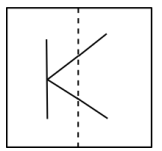
A transparent square sheet shown above is folded along the dotted line. The folded sheet will look like ________________.- Consider two rectangular sheets, Sheet M and Sheet N of dimensions 6 cm x 4 cm each.
Folding operation 1: The sheet is folded into half by joining the short edges of the current shape.
Folding operation 2: The sheet is folded into half by joining the long edges of the current shape.
Folding operation 1 is carried out on Sheet M three times.
Folding operation 2 is carried out on Sheet N three times.
The ratio of perimeters of the final folded shape of Sheet N to the final folded shape of Sheet M is ________.


