
A planar rectangular paper has two V-shaped pieces attached as shown below.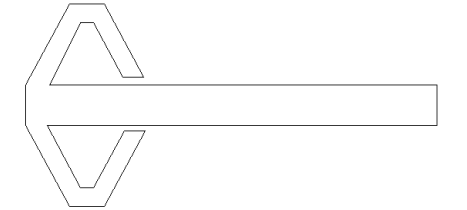
This piece of paper is folded to make the following closed three-dimensional object.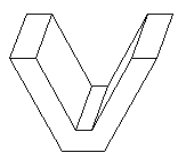
The number of folds required to form the above object is
To solve this problem, we need to determine the number of folds required to create the given 3D object from the provided 2D paper with V-shaped pieces. Here's the step-by-step explanation:
The diagram shows a rectangular piece of paper with two V-shaped sections. When folded, these sections help form the 3D object shown below:
- Observe that the central rectangular piece forms the main base of the 3D object. This piece requires initial folds to join edges and create a volume.
- Each V-shaped section functions as a side wall for the folded object. These sections will require specific folds along their lines to align properly and join with the base.
- Consider that each line where the paper bends counts as one fold. It’s important to account for each segment individually.
- As you attach each V-section to the main shape, aligning their edges will create additional folds.
- Given the complexity of the structure and the individual segments visible, the total folds needed to achieve the complete 3D shape are calculated as follows:
Counting both the central folds to form the structure initially and supporting folds for each V-shape to attach correctly, the total is nine folds.
Therefore, the correct answer is 9 folds.
Important Questions from Paper Folding
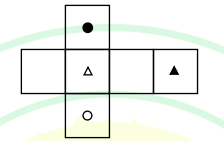
The paper as shown in the figure is folded to make a cube where each square corresponds to a particular face of the cube. Which one of the following options correctly represents the cube?
Note: The figures shown are representative.
Two identical sheets A and B, of dimensions $24$ cm $\times$ $16$ cm, can be folded into half using two distinct operations, FO1 or FO2.
In FO1, the axis of folding remains parallel to the initial long edge, and in FO2, the axis of folding remains parallel to the initial short edge.
If sheet A is folded twice using FO1, and sheet B is folded twice using FO2, the ratio of the perimeters of the final shapes of A and B is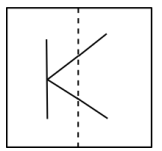
A transparent square sheet shown above is folded along the dotted line. The folded sheet will look like ________________.- Consider two rectangular sheets, Sheet M and Sheet N of dimensions 6 cm x 4 cm each.
Folding operation 1: The sheet is folded into half by joining the short edges of the current shape.
Folding operation 2: The sheet is folded into half by joining the long edges of the current shape.
Folding operation 1 is carried out on Sheet M three times.
Folding operation 2 is carried out on Sheet N three times.
The ratio of perimeters of the final folded shape of Sheet N to the final folded shape of Sheet M is ________. 
A transparent square sheet shown above is folded along the dotted line. The folded sheet will look like _____________


