
The paper as shown in the figure is folded to make a cube where each square corresponds to a particular face of the cube. Which one of the following options correctly represents the cube?
Note: The figures shown are representative.
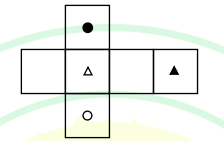

To solve this problem, we need to analyze the unfolded cube net given in the figure and visualize how it folds to form a cube. This involves determining which squares (or faces) will be adjacent to each other when folded.
The cube net given in the figure consists of six connected squares, representing the six faces of a cube. Let's consider the relationships between the faces:
- The bottom square (with a circle) is adjacent to four other squares. These squares will form the sides of the cube.
- The topmost square (with a solid dot) is opposite to the bottom one (circle). They will not touch each other directly once folded, but they will be on opposite faces.
- The squares on the left (with a triangle-unfilled) and the right (with a triangle-filled) determine which two faces will be on adjacent sides.
Given these observations, we can conclude that:
- The circle and dot are on opposite faces.
- The filled triangle and unfilled triangle are adjacent to the face with the dot.
Based on the connections, the correct 3D representation of the cube, considering the adjacency, is the option where these relations hold true. Hence, the cube configuration corresponding correctly with the folded net is the first option:
This configuration correctly matches the spatial relationships deduced from the cube net.
Important Questions from Paper Folding
Two identical sheets A and B, of dimensions $24$ cm $\times$ $16$ cm, can be folded into half using two distinct operations, FO1 or FO2.
In FO1, the axis of folding remains parallel to the initial long edge, and in FO2, the axis of folding remains parallel to the initial short edge.
If sheet A is folded twice using FO1, and sheet B is folded twice using FO2, the ratio of the perimeters of the final shapes of A and B is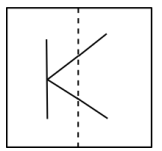
A transparent square sheet shown above is folded along the dotted line. The folded sheet will look like ________________.- Consider two rectangular sheets, Sheet M and Sheet N of dimensions 6 cm x 4 cm each.
Folding operation 1: The sheet is folded into half by joining the short edges of the current shape.
Folding operation 2: The sheet is folded into half by joining the long edges of the current shape.
Folding operation 1 is carried out on Sheet M three times.
Folding operation 2 is carried out on Sheet N three times.
The ratio of perimeters of the final folded shape of Sheet N to the final folded shape of Sheet M is ________. 
A transparent square sheet shown above is folded along the dotted line. The folded sheet will look like _____________
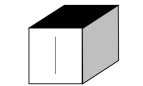
Consider a cube made by folding a single sheet of paper of appropriate shape.
The interior faces of the cube are all blank. However, the exterior faces that arenot visible in the above view may not be blank.
Which one of the following represents a possible unfolding of the cube?


