
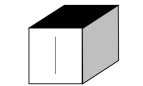
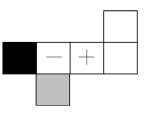
Consider a cube made by folding a single sheet of paper of appropriate shape.
The interior faces of the cube are all blank. However, the exterior faces that arenot visible in the above view may not be blank.
Which one of the following represents a possible unfolding of the cube?
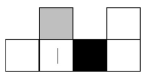
To solve the problem of determining which option represents a possible unfolding of the cube, we need to analyze the structure of a cube's net. A cube has six faces, and when unfolded, it can be represented as various combinations of connected squares.
Here is the initial view of the cube:
Observations from the cube:
- The visible faces include three continuous connected sides of the same structure.
- The faces opposite the visible ones are not seen in this view.
Let us consider the options provided and assess which one can correspond to a valid cube net:
-
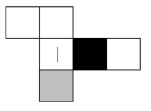
Here, the arrangement does not allow contiguous folding into a cube due to overlapping edges when folded.
-
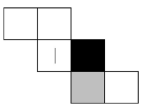
This arrangement results in disconnected areas when folded and cannot form a valid cube.
-
This arrangement forms a valid cube net. The central square with sides can fold upward, creating the top face and sides without overlapping or gaps.
-
This pattern results in non-adjacent edges connecting and cannot correctly form a cube.
After examining all options, option 3 is the only valid unfolding of the cube. Thus, the correct answer is:
This illustration adheres to the netting structure required to create a cube with proper arrangement of faces.
Important Questions from Paper Folding
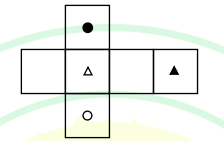
The paper as shown in the figure is folded to make a cube where each square corresponds to a particular face of the cube. Which one of the following options correctly represents the cube?
Note: The figures shown are representative.
Two identical sheets A and B, of dimensions $24$ cm $\times$ $16$ cm, can be folded into half using two distinct operations, FO1 or FO2.
In FO1, the axis of folding remains parallel to the initial long edge, and in FO2, the axis of folding remains parallel to the initial short edge.
If sheet A is folded twice using FO1, and sheet B is folded twice using FO2, the ratio of the perimeters of the final shapes of A and B is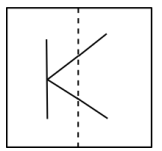
A transparent square sheet shown above is folded along the dotted line. The folded sheet will look like ________________.- Consider two rectangular sheets, Sheet M and Sheet N of dimensions 6 cm x 4 cm each.
Folding operation 1: The sheet is folded into half by joining the short edges of the current shape.
Folding operation 2: The sheet is folded into half by joining the long edges of the current shape.
Folding operation 1 is carried out on Sheet M three times.
Folding operation 2 is carried out on Sheet N three times.
The ratio of perimeters of the final folded shape of Sheet N to the final folded shape of Sheet M is ________. 
A transparent square sheet shown above is folded along the dotted line. The folded sheet will look like _____________


