
A circular sheet of paper is folded along the lines in the directions shown. The paper, after being punched in the final folded state as shown and unfolded in the reverse order of folding, will look like ___________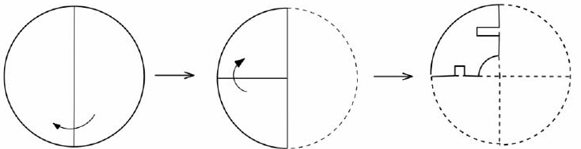

To solve this problem, we need to understand the process of folding and unfolding the paper and how the punch will appear on the unfolded sheet. Let's go through each step:
- Initial Fold: The circular sheet is initially folded in half along a vertical line. This results in a semicircle shape.
- Second Fold: The semicircle is further folded in half horizontally, resulting in a quarter-circle sector.
- Punching: The paper is punched at certain places when in the quarter-circle shape. The key is to note the position and pattern of these punches.
- Unfolding Process:
- First Unfold: When unfolded once, the quarter-circle becomes a semicircle again. The punch patterns will now appear symmetrically along the initial horizontal fold line.
- Second Unfold: Fully unfolding to the original circle will result in the symmetric appearance of the punch pattern along both initial fold lines, creating a repeated pattern in all four quadrants.
When we analyze the options, the option with punches that show this patterning and symmetry is the correct answer.
The above option matches the description and yields the symmetric punch pattern characteristic of the folding and unfolding process discussed.
Important Questions from Paper Folding
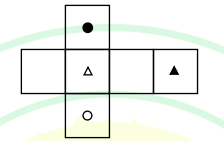
The paper as shown in the figure is folded to make a cube where each square corresponds to a particular face of the cube. Which one of the following options correctly represents the cube?
Note: The figures shown are representative.
Two identical sheets A and B, of dimensions $24$ cm $\times$ $16$ cm, can be folded into half using two distinct operations, FO1 or FO2.
In FO1, the axis of folding remains parallel to the initial long edge, and in FO2, the axis of folding remains parallel to the initial short edge.
If sheet A is folded twice using FO1, and sheet B is folded twice using FO2, the ratio of the perimeters of the final shapes of A and B is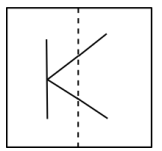
A transparent square sheet shown above is folded along the dotted line. The folded sheet will look like ________________.- Consider two rectangular sheets, Sheet M and Sheet N of dimensions 6 cm x 4 cm each.
Folding operation 1: The sheet is folded into half by joining the short edges of the current shape.
Folding operation 2: The sheet is folded into half by joining the long edges of the current shape.
Folding operation 1 is carried out on Sheet M three times.
Folding operation 2 is carried out on Sheet N three times.
The ratio of perimeters of the final folded shape of Sheet N to the final folded shape of Sheet M is ________. 
A transparent square sheet shown above is folded along the dotted line. The folded sheet will look like _____________


