
A sphere of radius $r$ cm is packed in a box of cubical shape.
What should be the minimum volume (in $cm^3$) of the box that can enclose the sphere?
Minimum Volume of Cubical Box Enclosing Sphere
To find the minimum volume of a cubical box that can enclose a sphere, we need to determine the smallest possible dimensions of the cube.
Relating Sphere Diameter to Cube Side
- The sphere has a radius of $r$ cm.
- The diameter of the sphere is twice the radius, which is $2r$ cm.
- For a cubical box to completely enclose the sphere, the length of each side of the cube must be at least equal to the diameter of the sphere.
- Therefore, the minimum side length ($s$) of the cubical box is $s = 2r$ cm.
Calculating Minimum Box Volume
The volume of a cube is calculated as side length cubed ($V = s^3$).
- Using the minimum side length $s = 2r$, the minimum volume ($V_{min}$) of the cubical box is: $ V_{min} = s^3 = (2r)^3 $
- Calculating the cube: $ V_{min} = 2^3 \times r^3 = 8r^3 $
Thus, the minimum volume of the cubical box required is $8r^3$ cubic centimeters.
Answer Explanation
The minimum volume required for the cubical box is achieved when its side length is exactly equal to the diameter of the sphere ($2r$). The volume calculation $(2r)^3$ correctly yields $8r^3$. Other options represent volumes that are too small to enclose the sphere.
Important Questions from Mensuration and Geometry
In the given figure, $P, Q$, and $R$ are three points on a circle of radius 10 cm with $O$ as its center, $\overline{PQ} = \overline{RQ}$, and $\angle PQR = 45^\circ$. The figure is representative.
The area of the shaded region $PQRO$ is ______________ cm$^2$.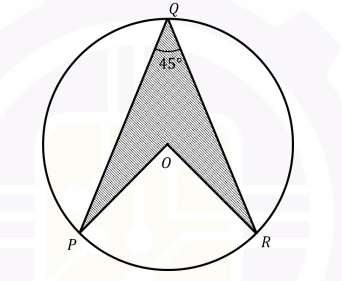
- A straight line $y = x - 1$ intersects a circle with center at $x = 1, y = 1$ and radius of magnitude 1 at two points. The length of the chord formed by this intersection is _______. (rounded off to three decimal places)
- The shell of a hollow spherical nanoparticle has a uniform thickness of 3 nanometers (nm). The outer radius of the nanoparticle is 5 nm. The ratio of the volume of the shell to the volume of the hollow core is ________
(Round off to one decimal place) - The volume of a sphere of diameter 1 unit is ______ than the volume of a cube of side 1 unit.
- A window is made up of a square portion and an equilateral triangle portion above it. The base of the triangular portion coincides with the upper side of the square. If the perimeter of the window is 6 m, the area of the window in $m^2$ is ______


