
A signal is represented by \(x\left( t \right) = \left\{ {\begin{array}{*{20}{c}} 1&{\left| t \right|}&{ < 1}\\ 0&{\left| t \right|}&{ > 1} \end{array}} \right.\) The Fourier transform of the convolved signal y(t) = x(2t) * x(t/2) is
\(\frac{4}{{{\omega ^2}}}\sin \left( {\frac{\omega }{2}} \right){\rm{sin}}\left( {2\omega } \right)\)
The scaled pulse transforms are2sin(ω/2)/ω and2sin(2ω)/ω. Convolution in time multiplies their transforms, giving \(Y(\omega)=4\sin(\omega/2)\sin(2\omega)/\omega^2\), with the continuous limiting value4 atω=0.
Important Questions from Standard Signals
The properties of Dirac Delta are
A. δ (t - to)=∞ if t = to
B. δ (t - to)=0 if t = to
C. δ (t - to)=0 if t ≠ to
D. δ (t - to)=∞ if t ≠ to
E. δ (t - to)=1 for all t = to
Choose the correct answer from the options given below:
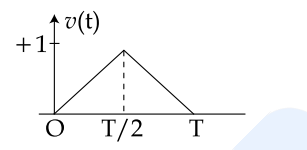
The correct expression of the following triangular wave is :
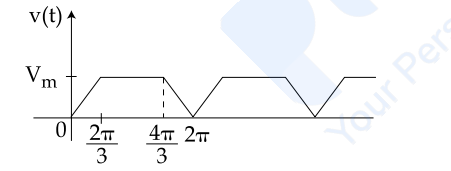
The average value of a periodic trapezoidal waveform is given by :
Consider a continuous-time signal
$x(t) = – t^2 \{u(t + 4) – u(t – 4)\}$
where $u(t)$ is the continuous-time unit step function. Let $\delta(t)$ be the continuous-time unit impulse function. The value of
$\int_{-\infty}^{\infty} x(t) \delta(t + 3)dt$ isWhich of the following is NOT one of the sampling techniques?


