
A right-angled cone (with base radius 5 cm and height 12 cm), as shown in the figure below, is rolled on the ground keeping the point P fixed until the point Q (at the base of the cone, as shown) touches the ground again. By what angle (in radians) about P does the cone travel?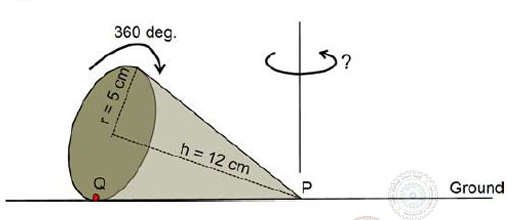
To find the angle about point P by which the cone travels, we need to analyze the rolling motion of the cone.
Step-by-Step Solution:
- First, observe that the cone is rolled on the ground, keeping point P fixed, until point Q touches the ground again. This means the cone makes a complete rotation about point P.
- The slant height of the cone forms the radius of the sector when unfolded. To find the slant height, use the Pythagorean theorem:
\(l = \sqrt{r^2 + h^2} = \sqrt{5^2 + 12^2} = \sqrt{25 + 144} = \sqrt{169} = 13 \, \text{cm}\)
- The circumference of the base of the cone is given by:
\(C = 2\pi r = 2\pi \times 5 = 10\pi \, \text{cm}\)
- When the cone is rolled, the arc length covered by the base of cone equals the circumference of the base.
- The angle of rotation about point P is given by the ratio of the arc length (circumference) to the circumference of the circle with radius \(l\) (when developed).
\(\text{Arc length} = 10\pi\)
\(\text{Circumference of circle with radius } l = 2\pi \times l = 2\pi \times 13 = 26\pi\)
The angle in radians is:
\(\theta = \frac{\text{Arc length}}{\text{circumference with radius} \, l} = \frac{10\pi}{26\pi} = \frac{10}{26} = \frac{5}{13}\)
Therefore, the angle by which the cone travels about point P is \(\frac{10\pi}{13}\) radians.
Thus, the correct answer is \(\frac{10\pi}{13}\).
Important Questions from Mensuration and Geometry
In the given figure, $P, Q$, and $R$ are three points on a circle of radius 10 cm with $O$ as its center, $\overline{PQ} = \overline{RQ}$, and $\angle PQR = 45^\circ$. The figure is representative.
The area of the shaded region $PQRO$ is ______________ cm$^2$.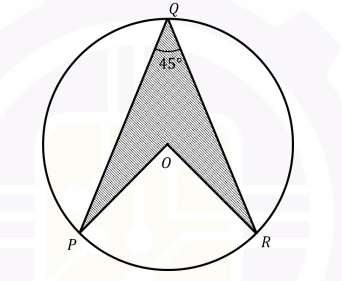
- A straight line $y = x - 1$ intersects a circle with center at $x = 1, y = 1$ and radius of magnitude 1 at two points. The length of the chord formed by this intersection is _______. (rounded off to three decimal places)
- The shell of a hollow spherical nanoparticle has a uniform thickness of 3 nanometers (nm). The outer radius of the nanoparticle is 5 nm. The ratio of the volume of the shell to the volume of the hollow core is ________
(Round off to one decimal place) - The volume of a sphere of diameter 1 unit is ______ than the volume of a cube of side 1 unit.
- A window is made up of a square portion and an equilateral triangle portion above it. The base of the triangular portion coincides with the upper side of the square. If the perimeter of the window is 6 m, the area of the window in $m^2$ is ______


