
A particle is confined in a box of length $L$ as shown below. If the potential $V_0$ is treated as a perturbation, including the first order correction, the ground state energy is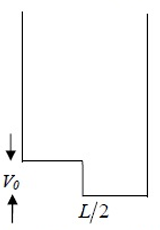
To find the ground state energy of a particle in a box of length \( L \) with a potential \( V_0 \) as a perturbation, we apply perturbation theory.
The unperturbed Hamiltonian for a particle in a one-dimensional box is given by:
\(H_0 = \frac{-\hbar^2}{2m} \frac{d^2}{dx^2}\)
The wave functions for the particle confined in a box with boundaries at 0 and \( L \) are:
\(\psi_n(x) = \sqrt{\frac{2}{L}} \sin\left(\frac{n\pi x}{L}\right)\)
and the energy levels are:
\(E_n^0 = \frac{\hbar^2 \pi^2 n^2}{2mL^2}\)
The perturbation is given by \( V_0 \) in the potential. The first-order correction to the energy is given by:
\(E_1 = \langle \psi_1 | V | \psi_1 \rangle\)
Since the potential is added only in the first half of the box, for \( 0 \leq x \leq \frac{L}{2} \), consider:
\(V(x) = \begin{cases} V_0, & 0 \leq x \leq \frac{L}{2} \\ 0, & \frac{L}{2} < x \leq L \end{cases}\)
Then, the first-order energy correction is:
\(E_1 = \int_0^{L} \psi_1(x) V(x) \psi_1(x) \, dx\)
Split the integral due to the piecewise potential:
\(E_1 = V_0 \int_0^{\frac{L}{2}} \left(\sqrt{\frac{2}{L}} \sin\left(\frac{\pi x}{L}\right)\right)^2 \, dx\)
Calculate:
\(E_1 = V_0 \cdot \frac{2}{L} \int_0^{\frac{L}{2}} \sin^2\left(\frac{\pi x}{L}\right) \, dx\)
Using the identity \(\sin^2 \theta = \frac{1 - \cos 2\theta}{2}\), evaluate the integral:
\(\int_0^{\frac{L}{2}} \sin^2\left(\frac{\pi x}{L}\right) \, dx = \frac{1}{2}\left[\frac{x}{2} - \frac{L}{4\pi}\sin\left(\frac{2\pi x}{L}\right) \right]_0^{\frac{L}{2}}\)
Evaluate the definite integral:
\(\int_0^{\frac{L}{2}} \sin^2\left(\frac{\pi x}{L}\right) \, dx = \frac{L}{4}\)
Hence, the first-order correction \(E_1 = V_0 \cdot \frac{2}{L} \cdot \frac{L}{4} = \frac{V_0}{2}\)
The corrected ground state energy including the first-order perturbation is thus:
\(E = E_1^0 + E_1 = \frac{\hbar^2\pi^2}{2mL^2} + \frac{V_0}{2}\)
Thus, the correct answer is \( E = \frac{\hbar^2\pi^2}{2mL^2} + \frac{V_0}{2} \).
Important Questions from Perturbation Theory Time Independent Degenerate
- If the perturbation $V = \lambda x^3$ is added to the Hamiltonian of a one-dimensional harmonic oscillator, the matrix element $\langle m|V|0 \rangle$ is/are non-zero for which of the following states? Here, the eigenstates of the harmonic oscillator are denoted by $|n\rangle$.
A two-level quantum system has energy eigenvalues $E_1$ and $E_2$. A perturbing potential $H' = \lambda \Delta \sigma_x$ is introduced, where $\Delta$ is a constant having dimensions of energy, $\lambda$ is a small dimensionless parameter, and $\sigma_x = \begin{pmatrix} 0 & 1 \\ 1 & 0 \end{pmatrix}$. The magnitudes of the first and the second order corrections to $E_1$ due to $H'$, respectively, are
A particle of mass $m$ in an infinite potential well of width $a$ is subjected to a perturbation, $V' = \frac{h^2}{40ma^2}$ as shown in figure, where $h$ is Planck's constant.
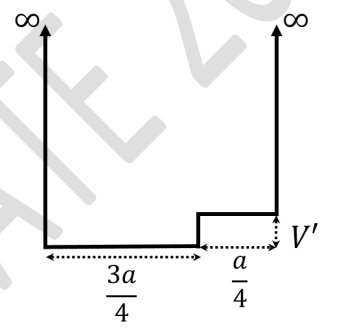
The first order energy shift of the fourth energy eigenstate due to this perturbation is
$(\frac{h^2}{Nma^2})$
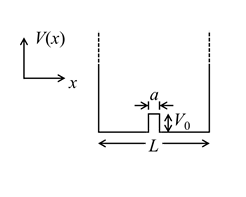
The value of $N$ is ____________ (in integer).The ground state energy of a particle of mass $m$ in an infinite potential well is $E_0$. It changes to $E_0(1 + \alpha \times 10^{-3})$, when there is a small potential bump of height $V_0 = \frac{\pi^2 \hbar^2}{50mL^2}$ and width $a = L/100$, as shown in the figure. The value of $\alpha$ is ________ (up to two decimal places).
- A particle of mass $m$ in the x-y plane is confined in an infinite two-dimensional well with vertices at $(0, 0)$, $(0, L)$, $(L, L)$, $(L, 0)$. The eigenfunctions of this particle are $\Psi_{n_x,n_y} = \sin(\frac{n_x\pi x}{L}) \sin(\frac{n_y\pi y}{L})$. If perturbation of the form $V = Cxy$, where $C$ is a real constant, is applied, then which of the following statements are correct for the first excited state?


