
Unperturbed Energy of a Particle in a 2D Infinite Well
The energy eigenvalues for a particle of mass $m$ in a 2D infinite square well of side length $L$ are given by:
$ E_{n_x,n_y} = \frac{\pi^2\hbar^2}{2mL^2}(n_x^2 + n_y^2) $
where $n_x$ and $n_y$ are positive integers ($n_x, n_y = 1, 2, 3, \dots$).
Identifying the First Excited State
The ground state corresponds to $(n_x, n_y) = (1, 1)$, with energy $E_{1,1} = \frac{\pi^2\hbar^2}{2mL^2}(1^2+1^2) = \frac{2\pi^2\hbar^2}{2mL^2}$.
The first excited state occurs for the next lowest energy values. These correspond to the quantum numbers $(n_x, n_y) = (1, 2)$ and $(2, 1)$.
The energy for these states is:
$ E_{1,2} = E_{2,1} = \frac{\pi^2\hbar^2}{2mL^2}(1^2 + 2^2) = \frac{\pi^2\hbar^2}{2mL^2}(1 + 4) = \frac{5\pi^2\hbar^2}{2mL^2} $
Degenerate Perturbation Theory for the First Excited State
The first excited state is doubly degenerate, meaning the states $\Psi_{1,2}$ and $\Psi_{2,1}$ have the same unperturbed energy $E_0 = \frac{5\pi^2\hbar^2}{2mL^2}$.
A perturbation $V = Cxy$ is applied. For degenerate states, the first-order energy corrections are found by diagonalizing the perturbation matrix within the subspace of degenerate states.
The relevant basis states are $\Psi_{1,2}$ and $\Psi_{2,1}$. The perturbation Hamiltonian matrix elements are:
- Diagonal elements: $a = \langle \Psi_{1,2} | Cxy | \Psi_{1,2} \rangle = \langle \Psi_{2,1} | Cxy | \Psi_{2,1} \rangle$.
- Off-diagonal elements: $b = \langle \Psi_{1,2} | Cxy | \Psi_{2,1} \rangle = \langle \Psi_{2,1} | Cxy | \Psi_{1,2} \rangle$.
Due to the symmetry of the wavefunctions and the perturbation, the diagonal elements are equal, and the off-diagonal elements are equal (and real, given $C$ is real).
Secular Equation for Energy Shifts
The energy shifts $\delta$ are the eigenvalues of the matrix representing the perturbation in the degenerate subspace. This leads to the secular equation:
$ \begin{vmatrix} a-\delta & b \\ b & a-\delta \end{vmatrix} = 0 $
Here, $a$ represents the expectation value of the perturbation in each degenerate state, and $b$ represents the coupling between the degenerate states via the perturbation. If $C \ne 0$, both $a$ and $b$ are real and non-zero constants. This equation correctly determines the energy shifts.
The energy shifts are not generally zero, as determined by the eigenvalues of this matrix ($a \pm b$).
Important Questions from Perturbation Theory Time Independent Degenerate
- If the perturbation $V = \lambda x^3$ is added to the Hamiltonian of a one-dimensional harmonic oscillator, the matrix element $\langle m|V|0 \rangle$ is/are non-zero for which of the following states? Here, the eigenstates of the harmonic oscillator are denoted by $|n\rangle$.
A two-level quantum system has energy eigenvalues $E_1$ and $E_2$. A perturbing potential $H' = \lambda \Delta \sigma_x$ is introduced, where $\Delta$ is a constant having dimensions of energy, $\lambda$ is a small dimensionless parameter, and $\sigma_x = \begin{pmatrix} 0 & 1 \\ 1 & 0 \end{pmatrix}$. The magnitudes of the first and the second order corrections to $E_1$ due to $H'$, respectively, are
A particle of mass $m$ in an infinite potential well of width $a$ is subjected to a perturbation, $V' = \frac{h^2}{40ma^2}$ as shown in figure, where $h$ is Planck's constant.
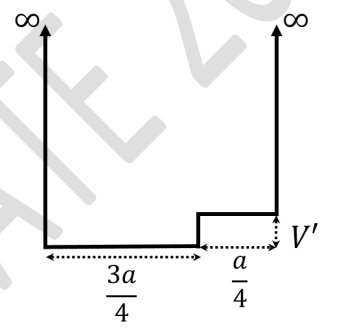
The first order energy shift of the fourth energy eigenstate due to this perturbation is
$(\frac{h^2}{Nma^2})$
The value of $N$ is ____________ (in integer).The ground state energy of a particle of mass $m$ in an infinite potential well is $E_0$. It changes to $E_0(1 + \alpha \times 10^{-3})$, when there is a small potential bump of height $V_0 = \frac{\pi^2 \hbar^2}{50mL^2}$ and width $a = L/100$, as shown in the figure. The value of $\alpha$ is ________ (up to two decimal places).
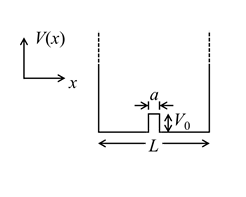
Consider the Hamiltonian $\hat{H} = \hat{H}_0 + \hat{H}'$ where
\[\hat{H}_0 = \begin{pmatrix} E & 0 & 0 \\ 0 & E & 0 \\ 0 & 0 & E \end{pmatrix}\]and $\hat{H}$ is the time independent perturbation given by
\[\hat{H}' = \begin{pmatrix} 0 & k & 0 \\ k & 0 & k \\ 0 & k & 0 \end{pmatrix}\]where $k>0$. If, the maximum energy eigenvalue of $\hat{H}$ is 3 eV corresponding to $E=2$ eV, the value of $k$ (rounded off to three decimal places) in eV is ________.


