
A two-level quantum system has energy eigenvalues $E_1$ and $E_2$. A perturbing potential $H' = \lambda \Delta \sigma_x$ is introduced, where $\Delta$ is a constant having dimensions of energy, $\lambda$ is a small dimensionless parameter, and $\sigma_x = \begin{pmatrix} 0 & 1 \\ 1 & 0 \end{pmatrix}$. The magnitudes of the first and the second order corrections to $E_1$ due to $H'$, respectively, are
Quantum Energy Corrections Calculation
This solution calculates the first and second-order energy corrections for a two-level quantum system under a specific perturbation.
First Order Energy Correction Calculation
The first-order energy correction ($E_1^{(1)}$) to the energy level $E_1$ is given by the expectation value of the perturbation Hamiltonian ($H'$) in the unperturbed state ($|\psi_1^{(0)}\rangle$) corresponding to $E_1$.
Formula:
$E_1^{(1)} = \langle \psi_1^{(0)} | H' | \psi_1^{(0)} \rangle$Given the perturbation $H' = \lambda \Delta \sigma_x$, where $\sigma_x = \begin{pmatrix} 0 & 1 \\ 1 & 0 \end{pmatrix}$. For a typical two-level system basis (e.g., eigenstates of $\sigma_z$), the diagonal matrix element $\langle \psi_1^{(0)} | \sigma_x | \psi_1^{(0)} \rangle$ is zero. This is because the unperturbed states are usually chosen such that they are not mixed by the diagonal part of the perturbation, or in this case, the perturbation itself is purely off-diagonal relative to the standard basis states.
Therefore, the first-order correction is:
$E_1^{(1)} = \lambda \Delta \langle \psi_1^{(0)} | \sigma_x | \psi_1^{(0)} \rangle = \lambda \Delta \times 0 = 0$The magnitude of the first-order correction is $|\!E_1^{(1)}\!| = 0$.
Second Order Energy Correction Calculation
The second-order energy correction ($E_1^{(2)}$) is given by the formula:
$E_1^{(2)} = \sum_{n \neq 1} \frac{|\langle \psi_n^{(0)} | H' | \psi_1^{(0)} \rangle|^2}{E_1^{(0)} - E_n^{(0)}}$For a two-level system, the sum includes only the other state ($n=2$), with energy $E_2^{(0)} = E_2$. So, $E_1^{(0)} = E_1$.
$E_1^{(2)} = \frac{|\langle \psi_2^{(0)} | H' | \psi_1^{(0)} \rangle|^2}{E_1 - E_2}$Substituting $H' = \lambda \Delta \sigma_x$:
$E_1^{(2)} = \frac{|\langle \psi_2^{(0)} | \lambda \Delta \sigma_x | \psi_1^{(0)} \rangle|^2}{E_1 - E_2} = \frac{(\lambda \Delta)^2 |\langle \psi_2^{(0)} | \sigma_x | \psi_1^{(0)} \rangle|^2}{E_1 - E_2}$Assuming $|\psi_1^{(0)}\rangle = \begin{pmatrix} 1 \\ 0 \end{pmatrix}$ and $|\psi_2^{(0)}\rangle = \begin{pmatrix} 0 \\ 1 \end{pmatrix}$ (standard basis), the matrix element is:
$\langle \psi_2^{(0)} | \sigma_x | \psi_1^{(0)} \rangle = \begin{pmatrix} 0 & 1 \end{pmatrix} \begin{pmatrix} 0 & 1 \\ 1 & 0 \end{pmatrix} \begin{pmatrix} 1 \\ 0 \end{pmatrix} = \begin{pmatrix} 0 & 1 \end{pmatrix} \begin{pmatrix} 0 \\ 1 \end{pmatrix} = 1$Thus, $|\langle \psi_2^{(0)} | \sigma_x | \psi_1^{(0)} \rangle|^2 = 1^2 = 1$.
The second-order correction is:
$E_1^{(2)} = \frac{(\lambda \Delta)^2 \times 1}{E_1 - E_2} = \frac{\lambda^2 \Delta^2}{E_1 - E_2}$The question asks for the magnitude. The magnitude of the second-order correction is:
$|E_1^{(2)}| = \left| \frac{\lambda^2 \Delta^2}{E_1 - E_2} \right| = \frac{\lambda^2 \Delta^2}{|E_1 - E_2|}$Conclusion:
The magnitudes of the first and second-order corrections to $E_1$ are $0$ and $\frac{\lambda^2 \Delta^2}{|E_1 - E_2|}$, respectively.
Important Questions from Perturbation Theory Time Independent Degenerate
- If the perturbation $V = \lambda x^3$ is added to the Hamiltonian of a one-dimensional harmonic oscillator, the matrix element $\langle m|V|0 \rangle$ is/are non-zero for which of the following states? Here, the eigenstates of the harmonic oscillator are denoted by $|n\rangle$.
A particle of mass $m$ in an infinite potential well of width $a$ is subjected to a perturbation, $V' = \frac{h^2}{40ma^2}$ as shown in figure, where $h$ is Planck's constant.
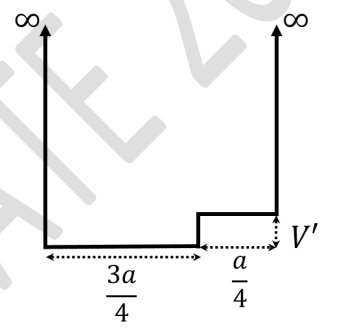
The first order energy shift of the fourth energy eigenstate due to this perturbation is
$(\frac{h^2}{Nma^2})$
The value of $N$ is ____________ (in integer).The ground state energy of a particle of mass $m$ in an infinite potential well is $E_0$. It changes to $E_0(1 + \alpha \times 10^{-3})$, when there is a small potential bump of height $V_0 = \frac{\pi^2 \hbar^2}{50mL^2}$ and width $a = L/100$, as shown in the figure. The value of $\alpha$ is ________ (up to two decimal places).
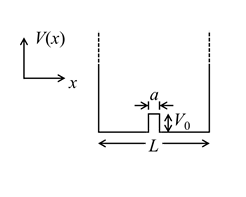
- A particle of mass $m$ in the x-y plane is confined in an infinite two-dimensional well with vertices at $(0, 0)$, $(0, L)$, $(L, L)$, $(L, 0)$. The eigenfunctions of this particle are $\Psi_{n_x,n_y} = \sin(\frac{n_x\pi x}{L}) \sin(\frac{n_y\pi y}{L})$. If perturbation of the form $V = Cxy$, where $C$ is a real constant, is applied, then which of the following statements are correct for the first excited state?
Consider the Hamiltonian $\hat{H} = \hat{H}_0 + \hat{H}'$ where
\[\hat{H}_0 = \begin{pmatrix} E & 0 & 0 \\ 0 & E & 0 \\ 0 & 0 & E \end{pmatrix}\]and $\hat{H}$ is the time independent perturbation given by
\[\hat{H}' = \begin{pmatrix} 0 & k & 0 \\ k & 0 & k \\ 0 & k & 0 \end{pmatrix}\]where $k>0$. If, the maximum energy eigenvalue of $\hat{H}$ is 3 eV corresponding to $E=2$ eV, the value of $k$ (rounded off to three decimal places) in eV is ________.


