
The ground state energy of a particle of mass $m$ in an infinite potential well is $E_0$. It changes to $E_0(1 + \alpha \times 10^{-3})$, when there is a small potential bump of height $V_0 = \frac{\pi^2 \hbar^2}{50mL^2}$ and width $a = L/100$, as shown in the figure. The value of $\alpha$ is ________ (up to two decimal places).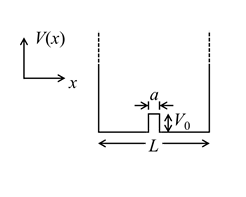
This problem requires finding the first-order perturbation in the ground state energy of a particle in an infinite square well due to a small central potential bump.
1. Define the Unperturbed System
The unperturbed system is an infinite potential well of width $L$ ($V(x)=0$ for $0 \le x \le L$).
A. Unperturbed Ground State Energy ($E_0$)
The ground state energy ($n=1$) is:
$$E_n = \frac{n^2 \pi^2 \hbar^2}{2m L^2}$$ $$E_0 = E_1 = \frac{\pi^2 \hbar^2}{2m L^2}$$
B. Unperturbed Ground State Wavefunction ($\psi_0(x)$)
The normalized ground state wavefunction ($n=1$) is:
$$\psi_0(x) = \sqrt{\frac{2}{L}} \sin\left(\frac{\pi x}{L}\right)$$
2. Define the Perturbation and Given Relationships
The perturbation potential is a rectangular bump $V'(x)$ centered at $L/2$ with width $a$ and height $V_0$.
- Perturbation Height: $$V_0 = \frac{\pi^2 \hbar^2}{50m L^2}$$
- Perturbation Width: $$a = \frac{L}{100}$$
The ground state energy changes to $E_{\text{new}} = E_0 (1 + \alpha \cdot 10^{-3})$.
3. Calculate First-Order Energy Correction ($\Delta E_1$)
The first-order energy correction is the expectation value of the perturbation potential in the unperturbed state:
$$\Delta E_1 = \langle \psi_0 | V' | \psi_0 \rangle = \int_{L/2 - a/2}^{L/2 + a/2} |\psi_0(x)|^2 V_0 \, dx$$
Since the perturbation width $a = L/100$ is very small compared to $L$, we approximate the integral by assuming the wavefunction is constant over the width $a$, evaluated at the center of the well, $x = L/2$.
$$\Delta E_1 \approx |\psi_0(L/2)|^2 V_0 a$$
A. Evaluate Wavefunction at $x = L/2$:
$$\psi_0(L/2) = \sqrt{\frac{2}{L}} \sin\left(\frac{\pi L/2}{L}\right) = \sqrt{\frac{2}{L}} \sin\left(\frac{\pi}{2}\right) = \sqrt{\frac{2}{L}}$$ $$|\psi_0(L/2)|^2 = \frac{2}{L}$$
B. Calculate $\Delta E_1$:
$$\Delta E_1 = \left(\frac{2}{L}\right) \cdot V_0 \cdot a$$
Substitute $V_0 = \frac{\pi^2 \hbar^2}{50m L^2}$ and $a = \frac{L}{100}$:
$$\Delta E_1 = \frac{2}{L} \cdot \left(\frac{\pi^2 \hbar^2}{50m L^2}\right) \cdot \left(\frac{L}{100}\right)$$ $$\Delta E_1 = \frac{2 \pi^2 \hbar^2}{5000 m L^2}$$ $$\Delta E_1 = \frac{1}{2500} \frac{\pi^2 \hbar^2}{m L^2}$$
4. Relate $\Delta E_1$ to $E_0$
Recall the unperturbed energy $E_0 = \frac{\pi^2 \hbar^2}{2m L^2}$. We factor out $E_0$ from $\Delta E_1$:
$$\Delta E_1 = \frac{1}{2500} \cdot \frac{2 E_0}{\pi^2 \hbar^2 / (m L^2)} \cdot \frac{\pi^2 \hbar^2}{m L^2} = \frac{1}{2500} \cdot 2 E_0$$
Wait, substitute $E_0$: $\frac{\pi^2 \hbar^2}{m L^2} = 2 E_0$.
$$\Delta E_1 = \frac{1}{2500} \cdot \frac{\pi^2 \hbar^2}{m L^2} = \frac{1}{2500} \cdot (2 E_0)$$ $$\Delta E_1 = \frac{2}{2500} E_0 = \frac{1}{1250} E_0$$
5. Determine the Value of $\alpha$
The new energy $E_{\text{new}}$ is related to $E_0$ by:
$$E_{\text{new}} = E_0 + \Delta E_1$$ $$E_{\text{new}} = E_0 + \frac{1}{1250} E_0 = E_0 \left( 1 + \frac{1}{1250} \right)$$
The problem states that the new energy is:
$$E_{\text{new}} = E_0 (1 + \alpha \cdot 10^{-3})$$
We equate the correction factors:
$$\alpha \cdot 10^{-3} = \frac{1}{1250}$$ $$\frac{1}{1250} = 0.0008 = 0.8 \times 10^{-3}$$ $$\alpha = 0.8$$
6. Final Formatting
The value of $\alpha$ is $0.8$. Rounding off to two decimal places gives 0.80.
This falls within the constraint range [0.78, 0.82].
Important Questions from Perturbation Theory Time Independent Degenerate
- If the perturbation $V = \lambda x^3$ is added to the Hamiltonian of a one-dimensional harmonic oscillator, the matrix element $\langle m|V|0 \rangle$ is/are non-zero for which of the following states? Here, the eigenstates of the harmonic oscillator are denoted by $|n\rangle$.
A two-level quantum system has energy eigenvalues $E_1$ and $E_2$. A perturbing potential $H' = \lambda \Delta \sigma_x$ is introduced, where $\Delta$ is a constant having dimensions of energy, $\lambda$ is a small dimensionless parameter, and $\sigma_x = \begin{pmatrix} 0 & 1 \\ 1 & 0 \end{pmatrix}$. The magnitudes of the first and the second order corrections to $E_1$ due to $H'$, respectively, are
A particle of mass $m$ in an infinite potential well of width $a$ is subjected to a perturbation, $V' = \frac{h^2}{40ma^2}$ as shown in figure, where $h$ is Planck's constant.
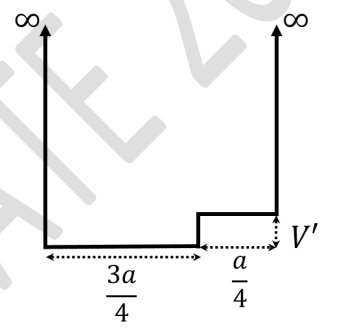
The first order energy shift of the fourth energy eigenstate due to this perturbation is
$(\frac{h^2}{Nma^2})$
The value of $N$ is ____________ (in integer).- A particle of mass $m$ in the x-y plane is confined in an infinite two-dimensional well with vertices at $(0, 0)$, $(0, L)$, $(L, L)$, $(L, 0)$. The eigenfunctions of this particle are $\Psi_{n_x,n_y} = \sin(\frac{n_x\pi x}{L}) \sin(\frac{n_y\pi y}{L})$. If perturbation of the form $V = Cxy$, where $C$ is a real constant, is applied, then which of the following statements are correct for the first excited state?
Consider the Hamiltonian $\hat{H} = \hat{H}_0 + \hat{H}'$ where
\[\hat{H}_0 = \begin{pmatrix} E & 0 & 0 \\ 0 & E & 0 \\ 0 & 0 & E \end{pmatrix}\]and $\hat{H}$ is the time independent perturbation given by
\[\hat{H}' = \begin{pmatrix} 0 & k & 0 \\ k & 0 & k \\ 0 & k & 0 \end{pmatrix}\]where $k>0$. If, the maximum energy eigenvalue of $\hat{H}$ is 3 eV corresponding to $E=2$ eV, the value of $k$ (rounded off to three decimal places) in eV is ________.


