A palindrome is a word that reads the same forwards and backwards. In a game of words, a player has the following two plates painted with letters. From the additional plates given in the options, which one of the combinations of additional plates would allow the player to construct a five-letter palindrome. The player should use all the five plates exactly once. The plates can be rotated in their plane.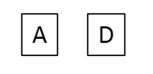
Problem Analysis
The goal is to construct a 5-letter palindrome using two initial plates, A and D, and one of the provided sets of three additional plates. A palindrome is a word that reads the same forwards and backwards (e.g., \( \text{RADAR} \)).
A crucial rule is that the plates can be rotated in their plane. This allows us to reorient letters to their standard form or potentially transform them into other characters.
Step-by-Step Solution
1. Identify the Palindrome Structure
A five-letter palindrome follows the pattern \( L_1 L_2 L_3 L_2 L_1 \). This means we need:
- Two pairs of identical letters (\( L_1 \) and \( L_2 \)).
- One unique middle letter (\( L_3 \)).
We already have the letters A and D.
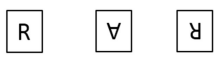
2. Evaluate Option (B)
Let's examine the plates in Option (B):
- First plate: The letter
R. - Second plate: An upside-down
A. Rotating this \( 180^\circ \) in its plane results in the letter A. - Third plate: A rotated
R. Rotating this \( 180^\circ \) in its plane results in the letter R.
By rotating these plates, we obtain the letters: \( \{R, A, R\} \).
3. Combine All Plates
Combining the original plates with the rotated plates from Option (B), we have the following set of five letters: $$ \{A, D\} \cup \{R, A, R\} = \{R, A, D, A, R\} $$
4. Construct the Palindrome
Using these five letters exactly once, we can form the word: $$ \mathbf{R \text{ — } A \text{ — } D \text{ — } A \text{ — } R} $$ This word is a valid five-letter palindrome.
Conclusion
Option (B) provides the necessary letters (after rotation) to complement the initial "A" and "D" plates and form the palindrome RADAR.
Final Answer: The correct combination is (B).
Important Questions from 2D 3D Pattern Visualization
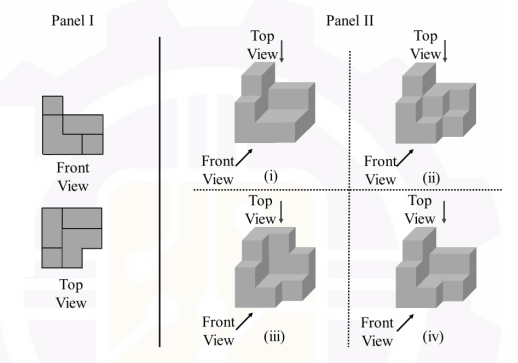
In Panel I of the figure below, the front view and top view of a structure are shown. Which one of the 3D structures shown in Panel II possesses the views shown in Panel I?
- Visualize two identical right circular cones such that one is inverted over the other and they share a common circular base. If a cutting plane passes through the vertices of the assembled cones, what shape does the outer boundary of the resulting cross-section make?
Three different views of a dice are shown in the figure below.
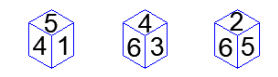
The piece of paper that can be folded to make this dice is
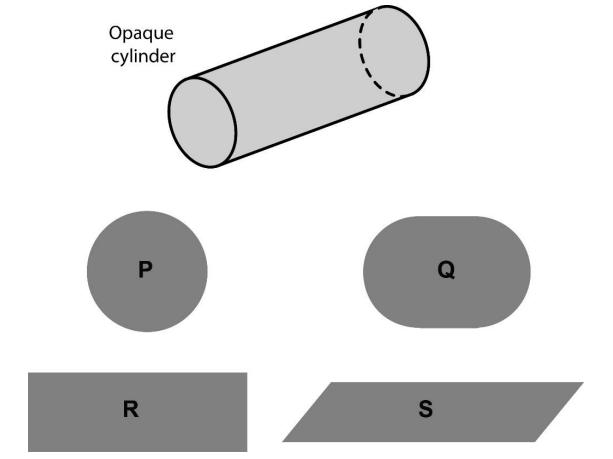
An opaque cylinder (shown below) is suspended in the path of a parallel beam of light, such that its shadow is cast on a screen oriented perpendicular to the direction of the light beam. The cylinder can be reoriented in any direction within the light beam. Under these conditions, which one of the shadows P, Q, R, and S is NOT possible?
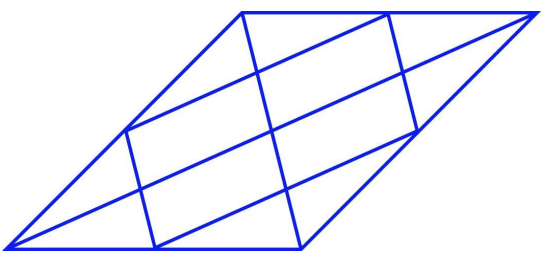
How many triangles are present in the given figure?