Physics Solution: Spring Extension Calculation
The problem involves a mass undergoing circular motion in a horizontal plane, where the centripetal force is provided by the tension in a spring.
Physics Principles Involved
- Centripetal Force: The force required to keep an object moving in a circular path. Formula: \$F_c = m \omega^2 r$
- Hooke's Law: The force exerted by a spring is proportional to its extension. Formula: \$T = k \Delta L$
Problem Analysis
Given:
- Mass, \$m = 0.5 \ kg$
- Natural length of spring, \$L_0 = 1 \ m$
- Spring constant, \$k = 800 \ N/m$
- Angular speed, \$\omega = 20 \ rad/s$
- Let the extension in the spring be \$\Delta L$.
- The radius of the circular path is the extended length: \$r = L_0 + \Delta L = 1 + \Delta L$
Calculation Steps
- The tension in the spring provides the centripetal force: \$T = F_c$.
- Substitute the formulas: \$k \Delta L = m \omega^2 r$.
- Substitute the expression for radius: \$k \Delta L = m \omega^2 (L_0 + \Delta L)$.
- Plug in the given values: \$800 \times \Delta L = 0.5 \times (20)^2 \times (1 + \Delta L)$.
- Simplify the equation: \$800 \Delta L = 0.5 \times 400 \times (1 + \Delta L)$ \$800 \Delta L = 200 \times (1 + \Delta L)$
- Solve for \$\Delta L$: \$800 \Delta L = 200 + 200 \Delta L$ \$800 \Delta L - 200 \Delta L = 200$ \$600 \Delta L = 200$ \$\Delta L = \frac{200}{600}$ \$\Delta L = \frac{1}{3} \ m$
Conclusion
The extension in the length of the spring is \$\frac{1}{3} \ m$.
Similar Questions
- Two masses $m$ and $2m$ are connected by a light string going over a pulley (disc) of mass $30m$ with radius $r=0.1 \text{ m}$. The pulley is mounted in a vertical plane and it is free to rotate about its axis. The $2m$ mass is released from rest and its speed when it has descended through a height of 3.6 m is _________ m/s. (Assume string does not slip and $g = 10 \text{ m/s}^2$)
- In a vernier callipers, 50 vernier scale divisions are equal to 48 main scale divisions. If one main scale division $= 0.05 \text{ mm}$, then the least count of the vernier callipers is _______ mm.
- A flexible chain of mass $m$ hangs between two fixed points at the same level. The inclination of the chain with the horizontal at the two points of support is $30^\circ$. Considering the equilibrium of each half of the chain, the tension of the chain at the lowest point is _______.
A thin uniform rod ($X$) of mass $M$ and length $L$ is pivoted at a height $\left(\frac{L}{3}\right)$ as shown in the figure. The rod is allowed to fall from a vertical position and lie horizontally on the table. The angular velocity of this rod when it hits the table top, is __________.
($g = \text{gravitational acceleration}$)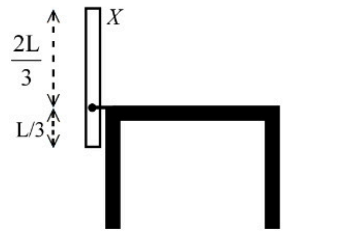
- A soap bubble of surface tension $0.04 \text{ N/m}$ is blown to a diameter of $7 \text{ cm}$. If $(15000 - x) \text{ }\mu\text{J}$ of work is done in blowing it further to make its diameter $14 \text{ cm}$, then the value of $x$ is _______.
($\pi = 22/7$) - A uniform solid cylinder of length $L$ and radius $R$ has moment of inertia about its axis equal to $I_1$. A small co-centric cylinder of length $L/2$ and radius $R/3$ carved from this cylinder has moment of inertia about its axis equals to $I_2$. The ratio $I_1/I_2$ is _______.
- Surface tension of two liquids (having same densities), $T_1$ and $T_2$, are measured using capillary rise method utilizing two tubes with inner radii of $r_1$ and $r_2$ where $r_1 > r_2$. The measured liquid heights in these tubes are $h_1$ and $h_2$ respectively. [Ignore the weight of the liquid about the lowest point of meniscus]. The heights $h_1$ and $h_2$ and surfaces tensions $T_1$ and $T_2$ satisfy the relation :
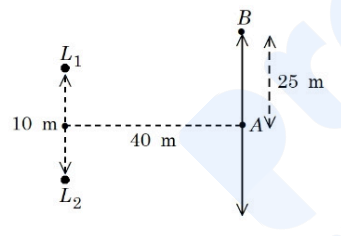
- Two cars $A$ and $B$ each of mass $10^3\text{ kg}$ are moving on parallel tracks separated by a distance of $10\text{ m}$, in same direction with speeds $72\text{ km/h}$ and $36\text{ km/h}$. The magnitude of angular momentum of car $A$ with respect to car $B$ is __________ $\text{J.s}$.
- A spherical body of radius $r$ and density $\sigma$ falls freely through a viscous liquid having density $\rho$ and viscosity $\eta$ and attains a terminal velocity $v_0$. Estimated maximum error in the quantity $\eta$ is : (Ignore errors associated with $\sigma, \rho$ and $g$, gravitational acceleration)
The pulley shown in figure is made using a thin rim and two rods of length equal to diameter of the rim. The rim and each rod have a mass of $M$. Two blocks of mass of $M$ and $m$ are attached to two ends of a light string passing over the pulley, which is hinged to rotate freely in vertical plane about its center. The magnitudes of the acceleration experienced by the blocks is __________
(assume no slipping of string on pulley).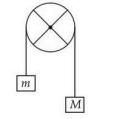
Important Questions from Mechanics
- Two masses $m$ and $2m$ are connected by a light string going over a pulley (disc) of mass $30m$ with radius $r=0.1 \text{ m}$. The pulley is mounted in a vertical plane and it is free to rotate about its axis. The $2m$ mass is released from rest and its speed when it has descended through a height of 3.6 m is _________ m/s. (Assume string does not slip and $g = 10 \text{ m/s}^2$)
- In a vernier callipers, 50 vernier scale divisions are equal to 48 main scale divisions. If one main scale division $= 0.05 \text{ mm}$, then the least count of the vernier callipers is _______ mm.
- A flexible chain of mass $m$ hangs between two fixed points at the same level. The inclination of the chain with the horizontal at the two points of support is $30^\circ$. Considering the equilibrium of each half of the chain, the tension of the chain at the lowest point is _______.
A thin uniform rod ($X$) of mass $M$ and length $L$ is pivoted at a height $\left(\frac{L}{3}\right)$ as shown in the figure. The rod is allowed to fall from a vertical position and lie horizontally on the table. The angular velocity of this rod when it hits the table top, is __________.
($g = \text{gravitational acceleration}$)- A soap bubble of surface tension $0.04 \text{ N/m}$ is blown to a diameter of $7 \text{ cm}$. If $(15000 - x) \text{ }\mu\text{J}$ of work is done in blowing it further to make its diameter $14 \text{ cm}$, then the value of $x$ is _______.
($\pi = 22/7$)