
(Rounded off to two decimal places)
Average Speed Calculation for Journey
This problem requires calculating the average speed for a journey that involves two distinct parts, each with a different distance and speed. The key formula to remember is:
$ \text{Average Speed} = \frac{\text{Total Distance}}{\text{Total Time}} $
We need to find the total distance traveled and the total time taken to complete the journey.
Journey Details Analysis
Let's break down the journey into two parts:
- Part 1: Distance = 200 km, Speed = 50 km/hr
- Part 2: Distance = 300 km, Speed = 60 km/hr
Calculating Total Distance
The total distance is the sum of the distances from both parts of the journey.
$ \text{Total Distance} = \text{Distance}_{\text{Part 1}} + \text{Distance}_{\text{Part 2}} $
$ \text{Total Distance} = 200 \text{ km} + 300 \text{ km} = 500 \text{ km} $
Calculating Time for Each Part
We use the formula: $ \text{Time} = \frac{\text{Distance}}{\text{Speed}} $
- Time for Part 1: $ \text{Time}_1 = \frac{200 \text{ km}}{50 \text{ km/hr}} = 4 \text{ hours} $
- Time for Part 2: $ \text{Time}_2 = \frac{300 \text{ km}}{60 \text{ km/hr}} = 5 \text{ hours} $
Calculating Total Time
The total time is the sum of the times taken for each part.
$ \text{Total Time} = \text{Time}_1 + \text{Time}_2 $
$ \text{Total Time} = 4 \text{ hours} + 5 \text{ hours} = 9 \text{ hours} $
Calculating Average Speed
Now we can calculate the average speed using the total distance and total time.
$ \text{Average Speed} = \frac{\text{Total Distance}}{\text{Total Time}} $
$ \text{Average Speed} = \frac{500 \text{ km}}{9 \text{ hours}} $
$ \text{Average Speed} \approx 55.555... \text{ km/hr} $
Rounding the Result
The question asks for the average speed rounded to two decimal places.
$ \text{Average Speed} \approx 55.56 \text{ km/hr} $
Therefore, the average speed for the whole journey is approximately 55.56 km/hr.
Important Questions from Speed Time & Distance (Notes)
- Ajay walks at a speed of 4 km/hr. He doubles his speed after reaching exactly half way. He walks for 12 hours in all. What is the total distance travelled by him ?
With a certain set of diameters, a tractor's front wheels make 2 revolutions (revs) for every 1 revolution of the rear wheels. The effect of changing wheel diameter(s) is shown in the following plot.
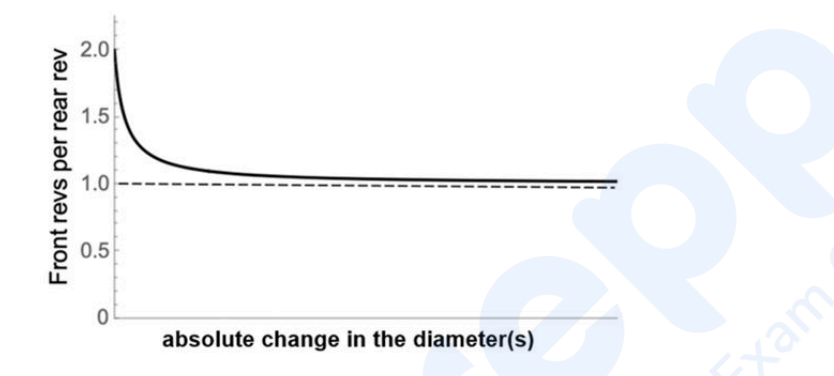
In this context, which of the following statements is CORRECT?- A train travels from Karnal to Kurukshetra at a speed of $90$ km/hr and returns at a speed of $92$ km/hr. If it takes $182$ hours for total travel, then find the distance between Karnal to Kurukshetra. (In Km)
A car covers 4 successive stretches of 3 km each at speed of 10 kmph, 20 kmph, 30 kmph and 60 kmph respectively. The average speed of the car for the entire journey is:
- A cyclist travels at 18 km/hr for 2.5 hours. What distance does he cover?


